
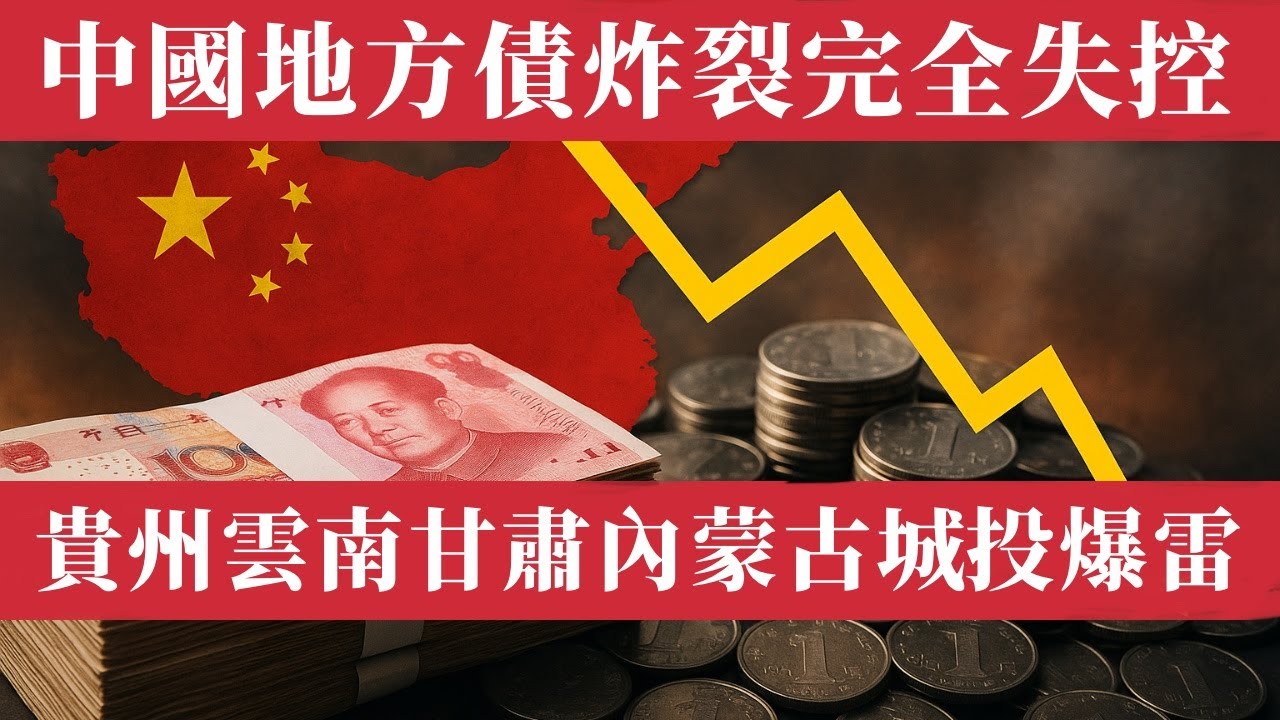
中國地方債務炸裂!9萬億新債全用來還舊債!借錢續命的財政幻覺崩塌,隱性債務高達94萬億,地賣不動、銀行錢見底、錢還不起、貴州、雲南、甘肅、內蒙古城投爆雷、連利息都還不起,2025地方財政危機全面失控!
“9 trillion” This is a number that ordinary people simply cannot imagine. If this money were stacked into a pile of hundred-yuan bills… It can be laid all the way from Beijing to Sanya It can circle the Earth three times. But this is not the asset of any particular wealthy person. Rather, it refers to the scale of debt incurred by Chinese local governments in the ten months leading up to 2025. Of the 9.1 trillion yuan, 60% was used to pay off debt. Borrowing new money to repay old debts is like a family burdened with debt. Use the child’s tuition fees to pay the mortgage I’ll borrow another loan to pay the electricity bill. In short, local government debt is completely out of control. “Let’s focus on surviving first.” “Who cares about future generations, the flood will be devastating!” This statement is becoming a true reflection of local finances. The latest data from the Ministry of Finance The first 10 months of 2025 Local governments across the country issued a total of RMB 9,106.2 billion in bonds. Year-on-year growth of 23%, setting a new record for the same period. Of these, 4.7 trillion yuan were newly issued bonds. Refinancing bonds totaled 4.4 trillion yuan That is to say, more than 62% of the money No new construction was undertaken. Instead, they are paying off old debts. Yes, local governments in China are mobilizing the entire nation’s resources. Pay back the debts you owe in the past This is no longer about developing the economy, but about desperately trying to prolong life. The collapse of the real estate market Like toppling dominoes The past 20 years Land is the biggest “cash cow” for local governments in China. Land prices and housing prices are soaring, bringing a boon to local government finances. But since 2023 Land transfer revenue plummeted by more than 40% In some prefecture-level cities, the land auction failure rate is as high as 80%. When land finance collapses Local finances are like a patient whose life support has been cut off. He lost his lifeline in an instant. In order to stabilize the economy and prevent a chain reaction Local governments have no choice but to borrow more. But every debt incurred There is no cash flow behind it. It’s not a factory that makes money. Instead, it includes roads, bridges, schools, subways, and industrial parks. One gray cement building after another Like a tombstone of the times The data from CBN is cold and hard. But it was like a heavy hammer blow. New bonds totaled 4.7 trillion yuan Refinancing bonds totaled 4.4 trillion yuan Year-on-year growth of 58% Even more astonishing is the first 10 months of this year Local governments also issued an additional 1.25 trillion yuan in special-purpose bonds. Specifically used to repay hidden debts and overdue payments to businesses. in other words These debts are not for the purpose of developing the future. Rather, it was to clear up the past. “Borrowing and repaying money” has become a nationwide fiscal norm. You might ask, “Won’t that end?” The answer is no. By the end of 2024 The outstanding balance of national government debt is 92.6 trillion yuan. Of this, local government statutory debt amounted to 47.5 trillion yuan. Hidden debt of 10.5 trillion yuan According to Goldman Sachs’ estimates The true total local government debt may be as high as 94 trillion yuan, equivalent to two-thirds of China’s annual GDP. This means Every county-level finance department, every urban investment company They’re all rolling a snowball that could explode at any moment. The snowball kept getting bigger and bigger. Interest grew like cancer cells. How will the debts of the “city investment company” be repaid? Experts from the Development Research Center of the State Council, Deputy Director of the Ministry of Commerce, local tycoon, and real estate executives They all spoke eloquently about principles, policies, and mechanisms. But no one can answer the simplest question. “How will you repay the money?” The so-called “city investment company” These are platform companies established by local governments. The names sound impressive: “City Investment,” “Water Investment,” and “Transportation Investment.” Essentially, it’s a shadow account of the government. Their mission is to do public service. Road construction, bridge building, pipeline laying But if charity projects don’t make money, where does the money come from? Previously relied on selling land Land is not selling now. Land prices plummeted precipitously. Urban investment companies are like bodies that have lost their blood circulation. Chronic necrosis begins once Shenzhen Metro invests in Vanke, and Shanghai Chengtou invests in Greenland Holdings. Barely surviving on dividends But now? Vanke will stop paying dividends after 2023. Greenland Group is heavily indebted Thousands of small and medium-sized urban investment companies across the country No replicable survival modes could be found. What’s even more terrifying is that the debt grows with you. Every debt has interest. Every month is eroding the finances If you borrow 200 million, the interest will be seven or eight million a year. It’s like someone falling into a deep well. Each struggle The light from the wellhead is farther away. In the meeting minutes of the local government “Debt risk is controllable” has become a frequently used phrase. But everyone knows The real risk is uncontrollable; it just hasn’t exploded yet. In this system, debt is not for repayment. Rather, it was to “roll” and roll down. Just like Minister Lan’s recent meaningful remark “Loan sharking debt is not considered government debt” Only consider implicit debt Moreover, it’s only a partial calculation. The meaning is very simple. If it’s not acknowledged on the books, it’s not considered a debt. This might explain Why are China’s fiscal statements always “stable”? But in reality Local banks are experiencing frequent runs, businesses are facing delayed payments, and migrant workers are struggling to receive their wages. All the “stability” is a borrowed illusion. In the local government’s books One term stands out particularly: “refinancing bonds”. It means using new money to pay off old money. But a more common way to put it is to rob Peter to pay Paul. Some people say it’s nothing. Businesses also frequently borrow new money to repay old debts. The problem is that companies borrow money to make money. Local governments borrowed money simply to “survive.” The difference lies here. According to the latest data from the Ministry of Finance and the National Development and Reform Commission Only in October 2025 Local governments were allowed to issue an additional 500 billion yuan in local government bonds. Of this, 300 billion yuan will be used to supplement local government finances. 200 billion yuan will be used for project construction in major economic provinces. However, those in the industry are well aware of the true meaning of the so-called “project construction”. It’s actually just another way to “extend one’s life.” Some scholars have done the math. Assuming the average interest rate on local government bonds is 3%. The 9 trillion yuan in bonds The annual interest expense is 270 billion yuan. This is only the visible part. If we add the interest on implicit debt The country spends over one trillion yuan annually to pay interest. Yes, they can’t even repay the principal. Even interest has become a heavy shackle. In this debt quagmire The logic of local finance has completely changed. In the past, the government initiated projects for development. The current projects are for borrowing money. Because as long as there’s a project, bonds can be issued. Issuing bonds would give us some breathing room. The cost of this struggle It’s a form of “self-emptying” of local finances. According to data from the National Bureau of Statistics In 2024, local government revenue nationwide declined by as much as 8.2%. However, spending increased by 5.7%. The difference can only be covered by borrowing money. that’s why “Hidden debt” is spreading like wildfire. According to Goldman Sachs estimates China’s local government financing platforms have a debt of up to 94 trillion yuan. It is half of the US federal government debt. But it is not included in the official data at all. It’s like that credit card bill hidden in the family ledger. Your unseen future is consuming you every day. Even more alarming is The other end of these debts is the local banking system. From whom do local government financing vehicles (LGFVs) borrow money? From local banks Who will bail out local government financing vehicles (LGFVs)? or local finance The government lends money to itself and guarantees it. He then issues more debt to repay it. This is a self-circulating illusion game. Once the funding chain breaks The chain reaction will be catastrophic. In fact Such “precursors to collapse” have appeared frequently. Some local government financing vehicles (LGFVs) in Guizhou, Yunnan, Gansu, Inner Mongolia, and other regions have defaulted on their debts. Some prefecture-level city governments have begun to “urge companies to postpone repayments”. The finance department even intervened to coordinate a “temporary suspension of repayments.” On the surface, it’s “coordination”. Actually, there was no money. In a prefecture-level city in Northeast China Fiscal revenue is no longer sufficient to pay civil servants’ salaries. Internal documents from local governments require “reducing non-essential spending.” The subtext of this statement is to prioritize wages. The others are all further back. Even so, many civil servants have complained. Wages delayed, performance bonuses cut, subsidies suspended However, the official stance remains optimistic. “The overall risk of local government debt is under control.” “Fiscal operations are stable” These words seem calm But none of them answer the core question. Where does the money come from? What will we rely on to repay the debt in the future? According to IMF data China’s total debt ratio has exceeded 300% of its GDP. Far exceeding the levels of developed countries such as Japan and the United States at the same stage of development. This means the country’s credit. It has already been overdrawn for thirty years. Some people say it doesn’t matter. China can issue unlimited bonds But don’t forget that money isn’t printed out of thin air. Inflation rises when the central bank loosens monetary policy. Debt expansion and currency devaluation People’s savings shrink and social trust collapses There are no winners in a debt cycle. The only way out is for someone to go bankrupt. But this time It wasn’t just one company that went bankrupt. Rather, it is the entire local fiscal system. Looking back on the past decade China’s local government debt is like a hidden secret. From “controllable” to “vigilant” and then to “strict control” Each change in expression Each of these is a critical point of crisis. And 2025 The critical point has finally arrived.
9萬億——這不是GDP的奇蹟,而是中國地方政府為了“續命”所借的新債。
2025年前十個月,全國地方債券發行總額高達91,062億元,創歷史新高,其中超過六成用來“還舊債”。這不是發展,而是求生。房地產熄火、土地賣不動、財政入不敷出,地方政府像失血的病人,靠債務吊著最後一口氣。
據高盛估算,中國地方隱性債務已高達94萬億,相當於全國GDP的三分之二。從雲南、貴州到遼寧,無數城投公司陷入違約、延期、重組的惡性循環,連“還利息”的錢都要再借新債。銀行資金鏈緊繃、企業帳款被拖、地方財政透支,公務員工資被砍、項目停擺——這場看不見硝煙的財政戰爭,正在撕裂中國的底層經濟。
所謂“再融資債券”,不過是拆東牆補西牆的幻覺;官方的“風險可控”,只是數字遊戲的安慰劑。當9萬億變成常態、當城投成為巨坑,當土地財政死去——中國的地方經濟,或許正在走向一場無聲的系統性崩潰。
深入揭開:地方債背後的“黑洞經濟”,以及它如何吞噬中國的未來、撕裂地方財政、逼迫城投和銀行系統走向絕境。
全面揭露地方債危機背後的「黑洞經濟」、財政崩塌的連鎖反應,以及隱藏在數據背後真實的社會危機。
#中國債務危機 #地方財政崩潰 #城投爆雷 #房地產危機 #隱性債務 #金融風暴 #經濟危機2025 #中國經濟真相
已開啟會員功能,希望能得到您的支持,讓更多人看到中國真相。感謝! ! !
https://www.youtube.com/channel/UCGPbBlQeLIJF1XqVkYmEV6g/join
記錄真實的中國,希望這片神奇的土地能正常一點。歡迎大家訂閱,謝謝!
本頻道接受投稿!只要您覺得您的素材符合本頻道的調性,讓更多人看到真實的中國,那麼請您與我聯絡:https://t.me/zaiyeshuo
邀請你加入「在野說Telegram交流群」暢所欲言:https://t.me/zaiyeshuoqun
邀請你關注在野說的Twitter:https://twitter.com/zaiyeshuo