
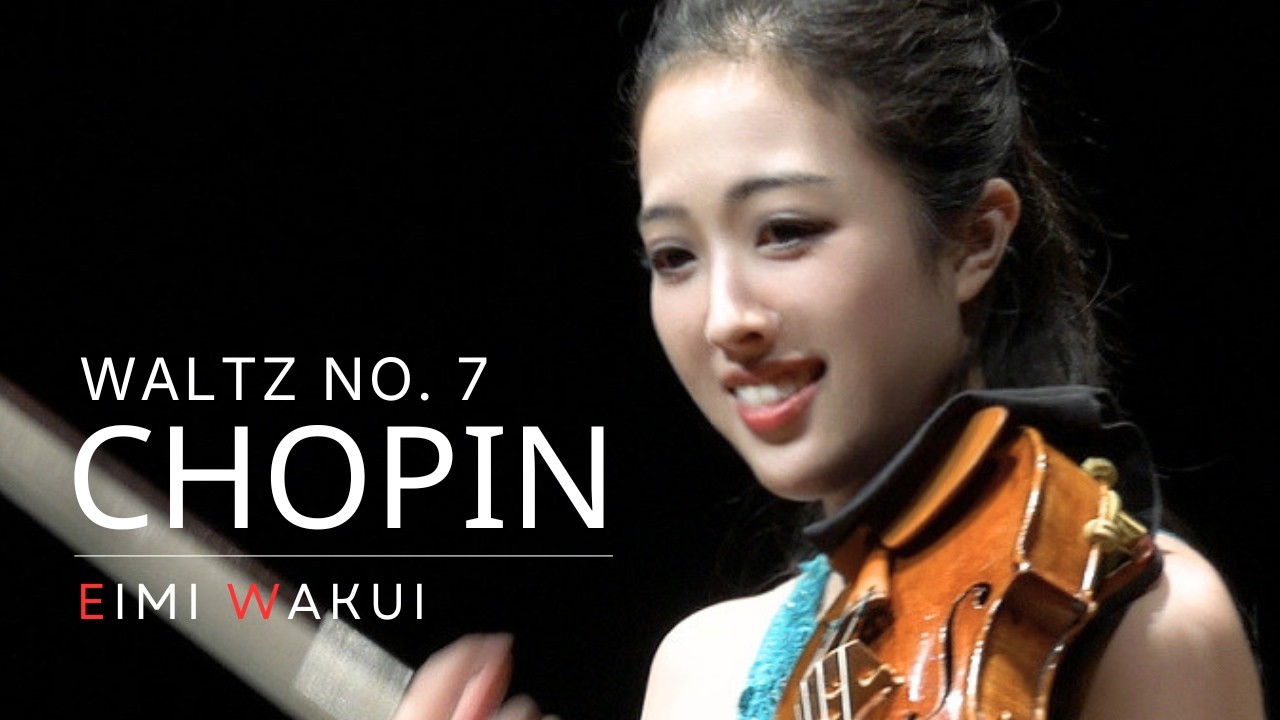
Chopin: Waltz No. 7, Op. 64 No. 2 (Violin and Piano) |Eimi Wakui
Frédéric Chopin (1810–1849)’s Waltz No. 7 in C-sharp Minor, Op. 64 No. 2, composed around 1847, belongs to his late period and is often regarded not as a piece for dancing, but as a poetic, introspective work meant for listening. Rather than brilliance and display, it reveals a deeply personal and reflective musical world.
Over the course of his life, Chopin wrote around 19 waltzes, transforming the genre from functional dance music into refined salon art. This particular work emerged during a time when his musical language had become more condensed and inward-looking. It also coincided with a difficult period in his personal life, including his separation from George Sand and a decline in his health. These circumstances are often felt in the music’s nostalgic atmosphere, tinged with subtle melancholy and emotional depth.
Originally written for solo piano, the piece is rich in expressive nuance, shaped by flexible rubato and sophisticated harmonic color. The opening in C-sharp minor unfolds with a quiet, contemplative character, while the middle section shifts into D-flat major, offering a contrasting moment of warmth and elegance. This interplay between minor and major tonalities evokes a sense of emotional fluctuation, almost like memories surfacing and fading away.
The version performed here is an arrangement by Ferdinand David (1810–1873), a distinguished violinist, composer, and close collaborator of Felix Mendelssohn. As concertmaster of the Leipzig Gewandhaus Orchestra, David was renowned for his understanding of the violin’s lyrical capabilities. Among various arrangements of this waltz, his stands out for preserving the original key of C-sharp minor, maintaining the work’s authentic tonal character.
Performing this piece on the violin brings a unique expressive dimension to Chopin’s music. The instrument’s ability to sustain sound, shape phrases with subtle inflection, and employ techniques such as portamento allows the melodic line to emerge as a truly vocal expression. In dialogue with the piano accompaniment, the music reveals new shades of lyricism and intimacy.
Beyond its origins as a dance, this waltz can be experienced as a poetic narrative in sound. I hope you enjoy this interpretation and discover its rich emotional landscape.
🎹 Piano: Alexey Sychev
——————————————————————
🎵 Welcome to the official Channel of Violinist Eimi Wakui.
I would be happy if you could like, Hype, comment and subscribe to my channel!
https://www.youtube.com/@EimiWakui
——————————————————————
🎻Another video↓
Chopin: Nocturne in E Flat Major Op. 9 No. 2 for Violin and Piano (arr. Sarasate)|Eimi Wakui
Liszt: Liebesträume Nr.3【Violin and Piano】|Eimi Wakui
Schumann:’’Träumerei” Kinderszenen, Op. 15 No. 7【Violin solo】|Eimi Wakui
Rachmaninoff: Rhapsody on a Theme of Paganini, Op. 43 – Var. 18【Violin and Piano】|Eimi Wakui
#chopin #waltz #violinperformance #classicalmusic #violinist