
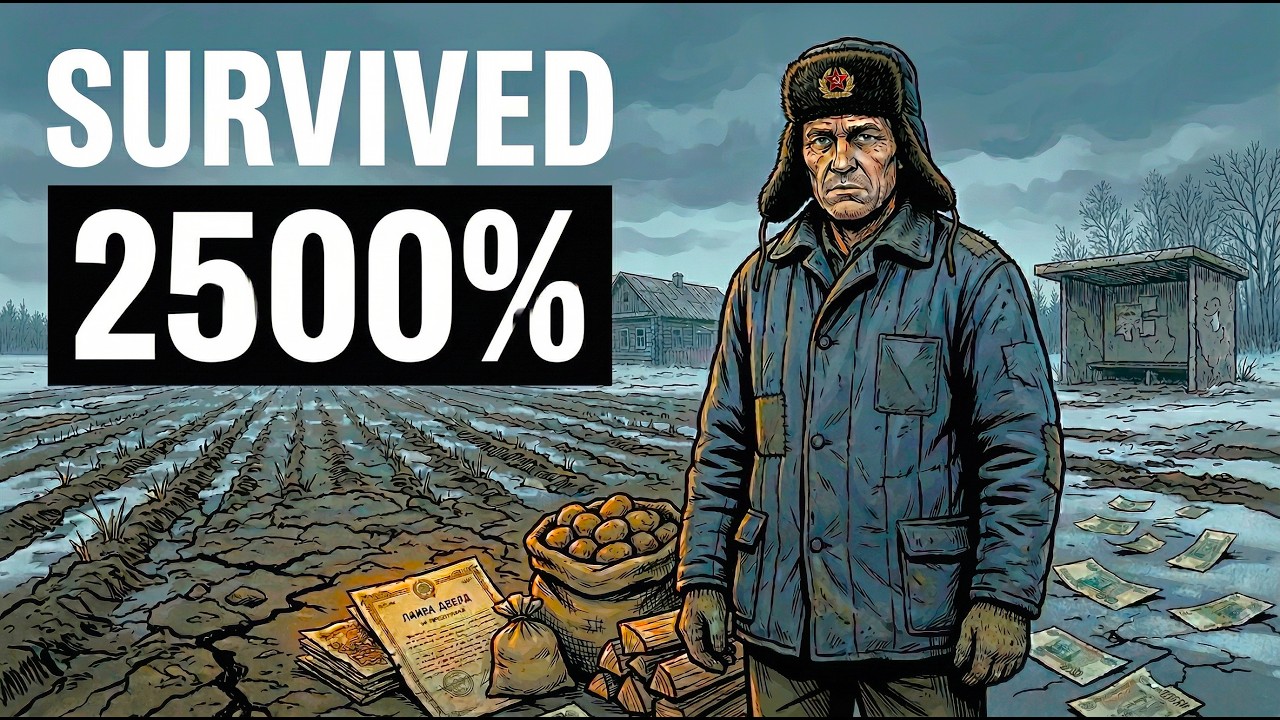
How a Farmer in 1990s Russia Protected His Money During Hyperinflation
In the early 1990s, as the Soviet Union collapsed, millions of people watched their life savings disappear almost overnight.
But not everyone lost everything.
Some — like a farmer in the Volga region — made a series of simple, practical decisions that allowed them to survive one of the most extreme hyperinflation events in modern history.
This video is not about predicting collapse.
It’s about understanding how people actually behave when money stops working — and what history shows about who makes it through.
Across different countries and different decades, the pattern repeats:
People who act early do better than those who wait
People who hold real goods outperform those who hold only cash
People who diversify survive longer than those who concentrate
People who stay quiet avoid unnecessary risk
These are not theories. These are observed behaviors, documented across real crises.
The question is not whether history will repeat exactly.
The question is whether you recognize the pattern early enough.
⚠️ Disclaimer
This video is for educational and informational purposes only and does not constitute financial advice.
📚 Sources & References
Books & Academic Works:
Adam Fergusson — When Money Dies (Weimar Germany hyperinflation)
Thomas J. Sargent — The Ends of Four Big Inflations
Peter Bernholz — Monetary Regimes and Inflation
Carmen M. Reinhart & Kenneth S. Rogoff — This Time Is Different
Philip Cagan — The Monetary Dynamics of Hyperinflation
Institutions & Data Sources:
International Monetary Fund (IMF inflation datasets)
World Bank (macroeconomic indicators)
Federal Reserve (monetary policy data)
Bank for International Settlements
hyperinflation, financial crisis survival, inflation hedge, protect your money, currency collapse, soviet union collapse, russian hyperinflation 1992, economic crisis strategy, store of value, inflation investing, wealth protection strategies, financial history lessons, story of money