
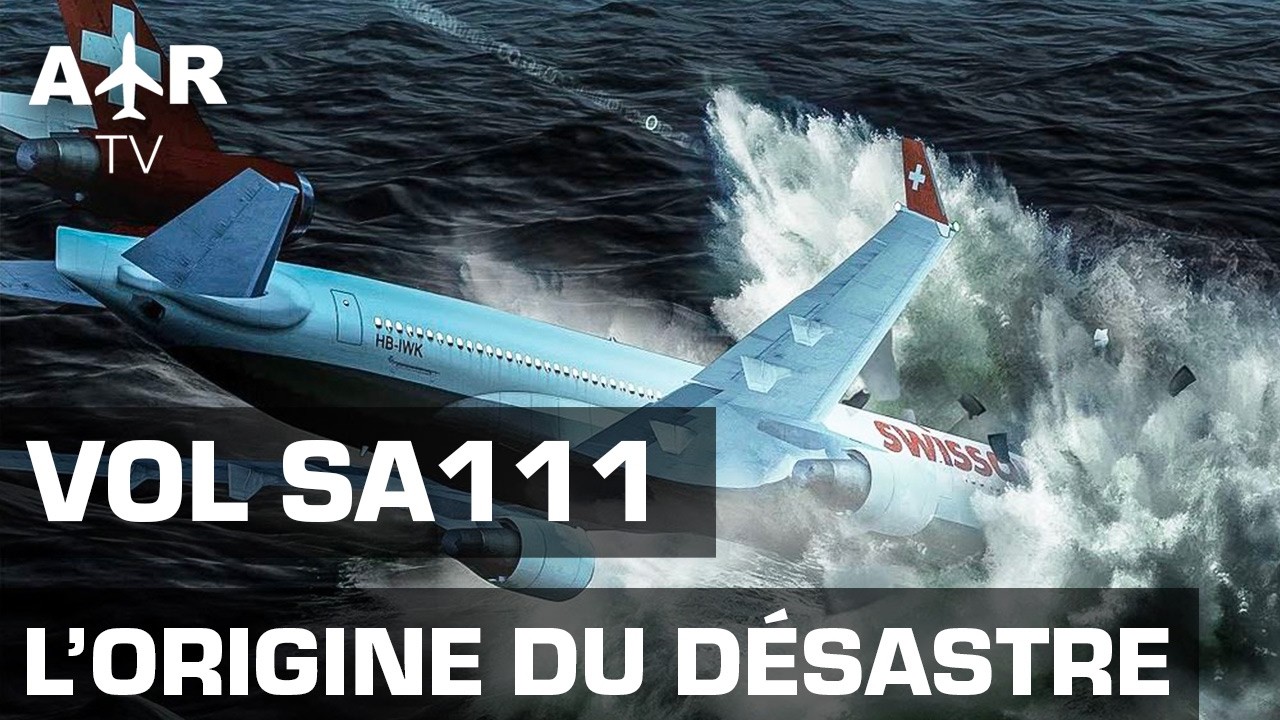
L’avion prend feu en plein ciel : l’enquête glaçante du vol SA111 | Documentaire Crash Aérien – GPN
On September 2, 1998, at 10:31 p.m.,
the inhabitants of the peaceful town of Peguiskov, Canada, heard
a tremendous explosion in the distance. A few minutes earlier,
at an altitude of 11,000 meters, suspicious smoke had appeared
in the cockpit of a passenger plane flying from New York to Geneva. This is the story of Swiss Air Flight 111. Late summer 1998, New York City. As every evening,
Swiss Air flight 11 is preparing to take off from Kennedy Airport
bound for Geneva. It is a prestigious and comfortable flight,
often used by representatives of major banks and
international organizations based in Switzerland. The aircraft is an MD11,
a wide-body aircraft manufactured by McDonal Douglas which, since 1986,
has replaced the old DC-10s. The MD 11 equips a large part
of the Swiss fleet, one of the safest companies in the world. Switzerland is renowned for its rigor,
the seriousness of its maintenance and the excellent competence of its crews. Takeoff checklist. Engine defrosting.
Not necessary. Received, not necessary. Automatic braking
in takeoff position. The crew tonight is led by
Commander Urs Zimmermann, 49. He is assisted by co-pilot
Stéphane Leroy, aged 37. The commander is a flight instructor
at Swissair and behind the smile lies a methodical and precise name. Pre-takeoff checklist. Ebec shutter, 15-degree shutter. 15 degrees displayed. On board, in addition to the 14 crew members,
the final count shows 215 passengers embarked. Among them were some celebrities
like Jonathan Mann, the head of the Global Programme on AIDS. And then, many anonymous people like this
23-year-old woman, Stephanie Chaud, who is returning to her parents’ home in Geneva. Stephanie had many strengths. She was very pretty. She was an intelligent girl. She had gone to New York because
she had been offered a position as a member of the World Economic Forum based in Geneva. And she wanted to take this trip
before she started working. She was adorable, a real sweetheart. Switzerland R 111, cleared for takeoff. Approved for takeoff received, Swiss R 111. At Swiss R, more than anywhere else,
safety is a true corporate culture. Every action, every gesture is codified
and must follow a precise procedure. Rotation. Do two. Swiss Air flight 111 is heading
northeast towards the Atlantic Ocean. The cruise begins
and routine sets in. A silent routine. For 15 minutes, the pilots
did not transmit any messages over the radio. It happens from time to time. They had not yet established contact
with what is called NATO, the North Atlantic Tracking System. It was a bit unusual. That said, it was just an error
in the radio frequency display. And when the plane entered the
NATO zone, it was not on the correct frequency. And apparently, they didn’t try
to contact anyone else. But it was weird. I agree with you. At first, we thought
it was interesting. The Atlantic
Air Traffic Control Centre is located
in the small town of Moncton, New Brunswick, Canada. Thirty minutes after leaving
New York, the commander makes contact with Moncton. Moncton from Swissair 111. Good evening on level 330. Swissair 111 from Moncton, good evening. Some moderate turbulence is reported
at all flight levels. Moncton, Swissair. For now, the night looks set to be calm. In the cabin, especially in first class,
tranquility can be complemented by the pleasure of the
food and the luxury of the amenities. At the time, Swissair had just
installed a brand new system on its planes , individual screens. This feature is only available
in first class and first class and allows access to a selection
of films, the Internet and even online betting. They had conducted a market study and they had realized that on long-haul flights,
these individual computer systems, as well as online betting with
a credit card, had a strong power,
let’s say, of seduction over customers. While
passengers are searching for the time of the next showing on their screens,
a completely different film is beginning to unfold in the cockpit at that moment. Gilles PATRON Do
n’t you feel something? Gilles PATRON: Yes, what is it? Gilles PATRON Go take a look,
I’ll take the orders. Gilles PATRON Yes, you’re in charge. Gilles PATRON The co-pilot checks the ceiling, and in particular the
air conditioning circuit vents. Gilles PATRON But he doesn’t notice anything. I saw nothing, Huyers. Nothing special. You called me, Commander? Stéphane and I just
smelled something burning. Do you feel anything? I can feel it too, yes. Did you already smell it
in the cabin before coming in here? No, absolutely not. We can see nothing and we can’t
feel anything either. That’s the air conditioning, right?
Yes. Please cut it. At that moment, the pilots were unaware that a terrible threat was present. Carpet behind their backs,
housed in the electrical panel located just behind the cockpit. A threat that, 45 seconds later, reappears. Here we go again. This time, things are
getting serious. Yes, it needs to be checked. Tell me the nearest airport. We’re going to need
approach charts and the weather forecast for the area. And Boston is very close. Things aren’t really getting better. Smoke in the control room triggers
a specific procedure outlined in a checklist. First step, prevent the inspection. Moncton from Swiss Air 11,
can you hear me? Good evening again.
United 920 of Moncton. At that moment, the controller is
in communication with another device. Incoming device, repeat. Swiss Air 111, let’s declare bang, bang, bang. There’s smoke in the cockpit. We request an
immediate diversion to, say, Boston. In aeronautical phraseology, the expression pan pan pan denotes a serious situation,
but without absolute urgency. Is it Boston you want? That sounds good to me, Boston. We need the
weather forecast and we’ll turn right. Swiss Air 11. Swiss Air 11 received. Hold at level 310.
310. For the first time since the accident,
one of the air traffic controllers who handled Swiss Air Flight 11 agrees
to testify on camera. My name is Bill Pickrel. On the evening of September 2, 1998,
I was one of two controllers on duty at the
Boston Control Center. The Pan-Pan-Pan signal,
which is used when a problem arises, is generally considered
an emergency message. Priority was immediately given to this
device and the person in charge called the Rescue Coordination Centre.
Their missionary. The captain’s request
surprised the controller somewhat. Boston is more than 500 kilometers
behind the plane, while Alifax is only 105 kilometers straight ahead. Often, when we encounter a problem,
we prefer to choose an airport that we know well. That’s one less thing to worry about. That’s what he thought of first. He notices that there is
smoke in the cockpit. He wonders why. He then looks for the nearest airport
where he can talk to a Swiss Air mechanic.
It was Boston. Swiss Air 111 from Moncton. Swiss Air 111, I’m listening. Wouldn’t you prefer Isfax? We’d better put on our masks. One minute. After consulting the map,
the captain agrees with the controller’s opinion. Halifax is much closer
and therefore much safer. Affirmative, Swiss Air 11. Refers to Halifax given our position. Received, Swiss Air 11. Proceed directly to Halifax,
descend to level 300. Level 300 to Halifax. Swiss Air 11. The crew of a British Airways flight,
cruising nearby, offer to help the two Swiss pilots. Swiss Air 11 from Speedbird 214. Are you flying the Halifax weather forecast? Swiss Air 111, we put on
the oxygen masks. Give us the weather forecast. Okay. The MD 11 leaves its altitude of
11,000 meters and begins its descent. At this stage, the pilots are managing
the situation perfectly. They rehearsed the actions
to be performed during the simulator sessions 100 times. And besides, at IFAC, it’s only about
a twenty-minute flight away. Swiss Air 111, cleared to 10,000
feet and the QNH is 2980. Received, Swiss Air 11. 2980, 10,000 feet, Swiss Air 11. Swiss Air 11, what are your
fuel reserves on board? Wait a second. Speedbird 1506 in the OK sector,
there is listening. Speedbird 1506 received. Swiss Air 11 – The first controller
only deals with high-altitude cruise flights. As Swissair 111 is now
descending, it will hand over to Bill Pickrell, the controller who
manages the low altitude and approach. At that moment, everything was normal. I indicated an initial altitude
to the pilot, but he requested permission
to descend to an intermediate level, giving time to prepare for landing. I thought he wanted to
put away the meal trays. For me, it meant that even if he
was in an abnormal situation, it was not
an extreme emergency for them. Watch your speed, Stéphane,
don’t go down too fast. Raised. Yes, Commander? There’s smoke in the station. Tell the crew to
prepare for landing. We will reach Halifax
in about twenty minutes. I’m going to start the checklists. Okay, Commander. The two Swiss checklists designed
for this type of situation are quite time-consuming to apply. They take about twenty minutes. The captain begins the
checklist while the co-pilot continues the descent towards Halifax. Stéphane, take the radio while
I go through the checklist. One hundred and nineteen,
point two for Swiss Air 111. Received, Swiss Air 111. Moncton from Swiss Air, good evening. We’re on a downhill slope. The plane passes the 25,000-foot mark,
approximately 9,000 meters. The descent is rapid,
but it is not an emergency descent. In fact, the crew, at that moment,
applied to the letter what the company planned for this type of situation. The heading is 0.5.0.
I repeat 05/0. Swissair 11, good evening. Descend to 3,000 feet. The QNH is at 29.79. From my point of view,
it gave all initial appearances that it should be – I initially thought
everything would be fine. Since everything was going normally,
I wasn’t going to have much to do to guide them to Halifax. Swiss Air 111, you can
descend to 3,000 feet. Or you can go down to an
intermediate level, if you prefer. The controller’s only concern is
the altitude. The plane is still very high as
the runway rapidly approaches. The plane was perhaps just
a tiny bit too high. I wanted to make sure that the pilots
knew how far they were from the airport, how many
kilometers they still had to travel. That way, they would be able to manage their
descent with full knowledge of the facts. Received.
For the moment, we are descending to 8,000 feet. Authorized at 3,000. I’ll keep you posted. Understood. You want me to direct you
for an approach to runway 06 in Halifax. Well received.
Number 06 is fine with us. Swiss Air 11. Swiss Air 11 received. Turn left for a heading of 030. Apart from the smoke in the cockpit,
the aircraft is behaving normally. And at this stage,
everything is working correctly. Only the pilots,
with their oxygen masks, have their mobility severely reduced. As a result, they need help
with every little movement. You called me, Commander? Yes, it’s been two minutes. Pass me the Alifax approach cards
in my briefcase. Join the crew.
Yes, Commander. Passengers now need to be notified
of the diversion to Halifax. In the cabin, everything is calm
and no one has noticed anything. We will be making an
unscheduled landing in Halifax in about twenty minutes. The seatbelt warning lights are on. Please raise your
tablet and your twist. But the plane is still at 20,000 feet. And this time, it’s frankly too
high for a runway less than 50 kilometers away. The slope would be too steep. There’s only one solution: we have to lengthen
the descent by taking a detour. You are 50 kilometers from
the runway threshold. Received. We need more than 50 kilometers. Could you please give me the frequency
and altitude? Received, Swissair 111. Turn left 4,3,6,0,
that will take you down a bit. Locator frequency, 1.09. 9.
Received. Unit 0.9.
9. We turn left, heading North. Swiss Air 111. We need to refuel it.
All right. The radio communications prove it; the crew
displays a very professional composure. On the ground, as always,
when an aircraft is in distress, the alert is triggered and the
Alifax airport emergency services get into position to receive
the aircraft within a few minutes. Switzerland at 11. When you have time,
you can tell me how many passengers you have on board and what
your fuel reserves are. It’s for emergency services. Received. We have 87 tonnes of fuel. We need to let go of some of it. We could do that
in the area during the descent. The controller thought the plane
was going to land directly. He did not expect such a
decision from the crew. That’s when
things got complicated. And after that, it only got worse
as our radio exchanges continued. To help the two Swiss pilots,
the controller will look for a fuel drop zone
as close as possible to Alifax. He suggests they use
St. Margaret’s Bay, about fifty kilometers
southwest of the airport. The other
possibility, if he had asked me to stay closer to
the field, was to have them turn right and then line them up
on any other track. The key was to make them describe
a circle or maintain a constant trajectory to avoid them
flying into the jettisoned fuel. Because that’s not good. An aircraft at the start of a long-haul flight has
full fuel tanks and the weight is too high to land
safely. So, in theory, fuel needs to be jettisoned
to lighten the load. In practice, you need to have the time
and clearly, the co-pilot has doubts about that. I’m staying as close as possible. He suggests we head south. Couldn’t we just
abandon the drop and land? No, we’re draining our fuel. Understood. Likewise, turn left
for a southerly heading for a drop. I gave them the direction towards
St. Margaret’s Bay so they could turn around. For me, that also proved that they
were not in an emergency situation since they had time
to dump their fuel over the water. Received, Swiss Air 111. Turn left,
heading 200 and notify me when you are ready for the drop. You will reach the coast
in about fifteen kilometers. You are currently less
than 40 kilometers from the airport. Received.
How many to the left? 200. We’ll stabilize at 10,000 feet
to jettison fuel. Understood. Maintain 10,000 feet. I will let you know when
you are above the water. It will be very soon. Received. Now, for the pilots,
the pressure is intense. Even though he is still managing the situation,
small details reduce the rise in stress. Is it the emergency checklist that’s pushing me
to the limit with the air conditioning? Yes.
Swissair 111, please repeat. Sorry, it wasn’t for you. Switzerland R 111, I
pressed the wrong button. Understood. The displayed speed
drops below 300 knots. Nothing is stabilizing.
Do what feels right, Stéphane. Switzerland R 111, continue
to the left, Heading 180. You will reach the coast
in 25 kilometers. Received. We continue to the left,
heading 180, Swissair 111. We maintain an altitude of 10,000 feet. Received.
Cabin power cut off. Cabin power cut off. The checklist includes cutting off
the cabin’s power supply. And this time, the passengers can no
longer ignore that something is happening. Yet, no one gives in to panic. Ladies and gentlemen, the ventilation has been
temporarily cut off in the cabin. Please remain calm. Our flight attendants will be passing through our area
with electric lances to prepare for landing. We will soon be landing in Halifax. The crew sought to reassure everyone,
describing the incident as minor. It is all the easier to believe since there is
still no visible smoke in the cabin. You will be staying within 50 or 60
kilometers of the airport in case you need to make an
emergency landing. Understood ?
That’s perfect. Let us know when we
can start the drop. Suddenly, the situation will deteriorate drastically
in the space of a few seconds . Autopilot disconnected.
Well received. Autopilot disconnected.
We’re switching to manual mode. The autopilot disengages as soon as
the onboard computers receive inconsistent information. At that moment, the pilots realized
that the smoke was no longer just coming from the air conditioning system. Swissair 111, settle in between 5,000
and 10,000 feet if you wish. One after another,
all the circuits fail. And in a matter of seconds,
the tension becomes extreme. Received.
We are between 12,000 and 9,000 feet. This time, it really is
an emergency situation. We declare a state of emergency.
Switzerland R11, at 01:24, Zulu. The two pilots are talking at the same time
on the frequency and in the control room, several
exchanges are taking place. As a result, the controller will
not hear a key phrase. We’re starting the drop. Swissair 11, let’s begin the drop. We need to sit down right now. Switzerland R 111, just a few more
kilometers, I’m following you. Received. We declare an
emergency situation, Switzerland R 111. Bill Pickrell did not hear
the request for an emergency landing. A failure that
will obsess him for months, for years. I’m not sure I’m able
to properly describe or express what I’m feeling. What happened that night,
I must have thought about it a good thousand times. Could I have
done more? Did I make a mistake? Do I bear any responsibility
for what happened? But I eventually understood that, in any
case, there was nothing else I could have done. We did everything we could. Things are moving very quickly now. The situation deteriorates second
by second, until the fire actually reaches
the piloting instruments. Go ahead, I’m in control. This time, it burns. All screens are dead.
We’re putting cramps in gold. We rely on backup instruments.
We remain at 302. Swiss Air 111, authorized to drop
fuel immediately. Let me know when it’s finished. Soon after,
I authorized him to dump his fuel, but he did not confirm. I wasn’t too worried. I thought he was
already in the middle of dropping out. And then they went through a checklist. They had lots of things to do
and we are taught to leave them alone in those situations.
They’re busy enough as it is. Swissair 111, confirmed. Fuel drop authorization. But no one will ever send
the slightest confirmation. Flight 111 entered a period of silence
that would last six long minutes before becoming a final silence. At 22:31, the MD11, with its 229 passengers
and crew members, crashed into the ocean. It must be rare to
feel so helpless. There is absolutely nothing we can do
except sit in front of our screens and hope that the echo of the aircraft
will turn back towards the airport. Obviously, that wasn’t the case. The next morning, a horrifying scene awaited the rescuers. In the days and weeks that
followed, only one body would be identified. All the others were
torn to pieces or swept away by the sea. That
night in Geneva, Yann Chau had a bad feeling about his
23-year-old daughter, Stéphanie. The night she was supposed to come home, I
don’t know why, but I was agitated. I fell asleep early and when I woke up, my wife was still awake. I asked her if she had
heard from Stephanie. No, but she wasn’t expecting it
since we knew she was on the plane at that time. She must have been hoping I would
pick her up at the airport in the morning. I woke up around 6:00 AM,
Geneva time. On television, they were talking about
the crash of Swiss Air Flight 111. I immediately agreed
that I was going to lose our daughter. Air traffic controller Bill Pickrell
is in shock. In 30 years of work,
he had never experienced such a tragedy. It’s a very strange experience. I’m not sure I can
clearly express what I felt.
We are here to provide a service. So of course,
we read stories of crashes in the mountains or in remote areas,
somewhere in a faraway country. But how could you imagine that this could
happen near your home? So when that happens,
I think we suddenly feel very alone. The Canadian Transportation Safety Board is
launching the largest investigation ever conducted in Canada. Initially, only one thing was clearly
established: a fire had broken out in the cockpit. Now the task is to find the causes. This investigation was
a real challenge. First, the wreckage
of the aircraft had to be found at a depth of 60 meters. And of course, the plane was in pieces. Several hundred
thousand fragments have been recovered. That was the first challenge. Then, once we had
all these pieces of debris, we still had to select the most
significant ones and, through them, discover how things
had happened and why. The investigators embark
on a five-step mission. First, divers
go down to examine the paving stones. And right away, they understand
that the task is superhuman. The plane was literally pulverized. The ground is littered with tiny debris. And besides, the season is not very favorable. We are in the North Atlantic
and the risks for divers increase with the arrival of autumn. The second step
involves remotely controlled vehicles provided by the US Navy
combing the site and beginning to provide investigators
with interesting information. But the problem remains. How can we recover the enormous quantity
of twisted metal pieces lying at the bottom of the water? We had to examine every
small piece of the plane. In the crash of Swiss Air 111,
we ended up with approximately two million pieces of equipment. We had to examine almost all of them
to rule out certain theories: terrorist attacks, bombs, various anomalies. The wreck eventually yielded its first
treasure: the two black boxes. With the flight data recorder,
investigators then discovered that the plane was still in perfect working order just minutes before the crash. The crew declared a bang, bang,
bang emergency because there was smoke in the cocktail we made afterwards. Upon examination, it was discovered that at that
precise moment, no anomaly, not the slightest irregularity
in the technical parameters, indicated any problem whatsoever. It was concluded that the device
was then in good working order. Apart from the smoke in the station which they
reported being present, everything was working correctly. It was when they began their descent
that the breakdowns multiplied, and at an increasingly rapid pace. Received, autopilot disconnected. But in reconstructing the sequence
of events, the technicians will encounter a major problem. Both black boxes also
stopped working during the last six minutes of the flight.
The circuits break down one after another during these 90
seconds where everything happens very quickly. The last thing we know for sure is
that both recorders were switched off. The fire destroyed the
power supplies to the black boxes, which therefore ceased to function. Six minutes of mystery and only one
certainty: there was a fire on board. A fire whose
origin is still unknown. The investigators
then move on to the third stage. The authorities are hiring barges to
dredge the seabed and bring up as many pieces of the MD 11 as possible. This is how
one of the two engines will be recovered. Then it was the turn of one of the two
landing gears, almost intact. In the end, of the pieces recovered,
these will be the two most important pieces. The rest of the device is in the form
of crumbs scattered on the seabed. Fourth step, a makeshift laboratory
is set up in a military hangar to accommodate investigators,
forensic experts, specialists from Boeing and Swissair,
as well as representatives of the Canadian police. Every day, trucks come to drop off
tons of debris recovered from the bottom of the mine. Each piece must be identified,
classified and finally analyzed. A monumental task. The hangar was quickly occupied by the biggest puzzle in the history
of aviation. A puzzle which we hope will help us
understand how a seemingly minor fire could have led
to a terrible catastrophe in just a few minutes. The aircraft’s 250 kilometers of electrical wiring
are being examined under a microscope. To look for traces of
electric arcs or sparks, anything that could have ignited
flammable materials. Thanks to the imprint
left by the flames, investigators became certain
that the fire started just behind the co-pilot, at the rear of the cockpit. And a careful study of the
electrical installation leads them to suspect the personal screens of the first
class and the class to be done. The system had serious flaws. It got very hot and
consumed a huge amount of electricity. It
significantly increased the cabin temperature because it was
running continuously. They didn’t install any switches
or a proper cooling system. Canadian investigators believe they have
finally found the crucial piece of evidence they were missing. We mentioned it in our report. A design flaw was found
in the way this computer system, installed in first class
and in the to-do class, was integrated with the rest of the
electrical installation of the device. For example, by cutting off the power
to the cabin, the captain thought he would eliminate all
electrical power in the passenger area. He was unaware that the individual screens
were still powered. Ask the pilot. Most of them will tell you that by
cutting the power in the cabin, it cuts the electricity everywhere
except in the cockpit. They think they’ve gotten rid of the problem. They now only have to concentrate
on the piloting itself. Only there, the video system was
somehow bypassing the switch. Switzerland immediately decided to remove all
personal screens installed on these devices. As for the American accident investigation bureau
, it orders the inspection of the electrical wiring in the cockpit
of all MD11s in service on American territory. Even though in the Swiss case,
isolating personal screens would not have fundamentally
changed much. When the pilot flipped the switch,
the fire had already spread. This element therefore has no real
impact on either the start of the fire or its spread
on board Swiss Air 111. The conclusion is inescapable:
personal screens are not the only cause of the crash. As always, there are others. To track them down,
investigators are beginning their fifth and final step: the reconstruction
of the MD 11 from the wreckage of the aircraft. A metal frame shaped to fit
the device allows them to put each piece of metal back in its original position
. This giant puzzle will allow them
to make a fundamental discovery. The fire spread very
quickly, from the cockpit towards the first-class cabins. Some parts were subjected
to temperatures exceeding 600 degrees. Clearly, the pilots were
unaware of how quickly the fire was spreading. And some are wondering. By strictly adhering to the procedure,
didn’t the crew condemn themselves? Shouldn’t he have initiated an
emergency descent and landed as quickly as possible, Twister 111? I pressed the wrong button. Some companies emphasize
the importance of landing as quickly as possible. Afterwards, we have plenty of time
to complete the checklist. For others, on the contrary,
the checklist is paramount. We only attract attention afterwards,
if the problem persists. This actually contradicts what
student pilots are taught from the very beginning. Smoke means there’s a fire. And in case of fire,
we land as quickly as possible. Emergency lighting activated. Emergency lighting activated. Unfortunately, in this case, the
checklist had things backwards. The initial aim was not to divert ourselves,
but to see if it was possible to resolve the difficulty. And that’s how you end up with
a problem that hits you unexpectedly. Received. We need more than 50 –
Canadian investigators who rely on the timeline do not share this view. For them, in all circumstances,
Swiss theft was doomed. In practical terms, the pilots
did not have time to land. Received. Unit zero. According to our calculations,
we started from an optimal descent starting point at 30,000 feet. This is the altitude recorded at around
10:14 PM that evening. From there, it would have taken them 13 minutes to land, which gives us 22:27. However, the malfunctions started
occurring from 22:24. It is therefore estimated that in such
circumstances, the crew would never have been able to land given
the time they had. Whatever the cause,
the fire spread at a terrifying speed. And investigators now know
that individual screens are not solely responsible. Therefore,
further research is needed. A year later, a new,
even more spectacular operation began. Canadian authorities are outright hiring
the services of a Dutch dredger, the Queen of the Netherlands. Objective: to recover all the
aircraft debris remaining at the bottom of the sea. The ship is equipped with a gigantic
suction system designed to collect even the smallest fragments. This will allow us to pump several hundred
thousand tons of seawater, silt and debris, which will then
be collected in the central hold. Once brought ashore, the cargo is stored
in a specially designed enclosure. Investigators thus recovered an
additional million coins, all from the shameless theft. In total, 98% of the plane
was brought back to the surface. And so begins an endless sorting process
to identify each piece, each detail, and to
further improve the reconstruction of the aircraft. Until the day when, finally,
after years of work and patience, the truth finally emerges. We searched for all sources of heat that could have started a fire in that area of the device. It was discovered that an electric arc,
originating from a cable, had set fire to the
metallized polyethylene terephthalate that covers the insulating mattresses. This polyethylene electrolyte,
which is found on many airliners, has nevertheless successfully passed
the flammability tests in force in the aeronautical industry. The investigation then takes on
a completely different character. The problem no longer concerns only
Swiss and its first- class facilities, but
the entire global fleet, most of which is equipped
with this type of material. Switzerland r 111, I’m listening. Would n’t you prefer Halifax? The material that was in that
plane was highly flammable. And even if he had passed the test,
he was feeding the flames and allowing them to spread. We therefore focused on the flammability
of materials and the need to review the criteria for obtaining
certifications. And that doesn’t just apply
to thermal and acoustic insulation mattresses,
it applies to all the materials found on board airplanes, most of
the time in inaccessible areas. This time, the investigators
reconstructed the entire film. An electric arc that generates
sparks, which ignite the insulating material, which, in turn,
sets fire to the foam and plastic. While the crew was applying
procedure and 14 minutes after the first message Pan, Pan, Pan,
the fire destroyed all electronic systems and even the
black boxes stopped working. The
DNA traces found on the pilots’ seats constitute the only ten
relating to the last six minutes of the flight. The co-pilot remained in his seat until the
end, while the captain was standing, probably behind,
fighting the flames. We’re going back to using backup instruments. We remain at 300 meters. The
co-pilot was probably trying to find a place to land
an aircraft of that size. He didn’t have much
manpower available. He only had a few
cockpit instruments left. He had to look for a clue indicating
where to land his plane or even attempt a forced water landing. What we do know is that the co-pilot
was sitting in his seat. Was he conscious or not? Was he badly burned? We don’t know that. However, we know that the captain was not in his seat. He was probably trying
to put out the flames. When we found the checklists,
their page had melted. They had therefore used it
to fight the fire. At 10:30 p.m. Alifax time,
the co-pilot shut down the right engine. Probably because a false alarm
indicated that it was on fire. This action proves above all that one minute
before the crash, the co-pilot was still alive and operational. However, during the last few minutes,
no one knows when the passengers fully realized
the seriousness of the situation. Traces of soot
and smoke were found up to the ceiling of the classroom, but it is unknown whether the passengers
smelled the smoke or not. DNA analysis proves, in any case, that they had no residues in their bodies. The plane hit the sea
with a force of 350 G. All 229 occupants died instantly. Investigators spent four and a
half years examining the wreckage of Swiss Air 111. The Canadian government spent 35 million
euros on this investigation, the largest ever conducted in Canada. But their conclusion is crucial and calls
into question the criteria used by the aeronautical industry. This investigation
made it possible to analyze the materials found on board the devices. The speed at which the fire spread surprised us
, and it wasn’t just us who were surprised. That’s why we’re insisting.
Stricter standards must be imposed regarding the flammability
of materials used in aircraft. The problem lies not only in
the flammable materials, but also in the fact that they are not visible. Once a fire has broken out on board,
time is working against you. Yann Chau waited four years
to find out the truth about the causes of his daughter’s death. Thanks to the meticulous work of the investigators,
today, he… But that did not calm his anger towards Suisser. Responsibilities need to be established. If you are complicit in a wrongdoing,
you must answer for your actions. And if you don’t take
responsibility, then you’re a coward. There, he hides behind
the Swiss flag. I can’t believe it. After the disaster,
Suisser had the flammable insulation removed from all of these devices. The company is also modifying its
checklists, reducing reaction time in the event of smoke appearing
in the cockpit. Swissair had all of these MD11s modified
based on the findings of the investigation. She had cameras
and smoke detectors installed, even in inaccessible areas. The pilots monitor this
on a control screen. And so, in case of a problem,
they can see where it is happening and use a fire extinguishing agent. It saves them time. And time is what matters
most in case of a fire. But for Suisseair,
it is already too late. Riddled with financial problems, the
company went bankrupt in October 2000. A real shock in
the aviation world. As for the flammable insulation,
responsible for the spread of the fire,
it is still on board 60% of airliners currently in service. Thankfully, not for much longer. Metallized polyethylene terephthalate has almost disappeared from new aircraft and certification standards relating
to the flammability of these materials have been revised. The law has not yet been passed, but we are eager for the criteria to be strengthened. The administration of the American civil operation
requires the removal of this material from all aircraft by 2005. A date that could be postponed given
the economic situation of the companies since September 11. The industry is trying to change that. The entire sector is working on it,
but companies are not doing it as quickly as they could. That said, everything comes at a cost. We always go for money. How much will it cost
to replace all of this? Is it worth doing this
on a plane that we’re going to scrap in a few years? We have to live with certain
economic realities. Yann Chau will forever be marked by the brutal and violent death of his daughter. He left his wife and fortune
in Geneva to open a small restaurant in Nova Scotia, overlooking the sea
where Stephanie met her death. Why choose
this particular corner of Nova Scotia? Lots of people have told me:
We totally understand, you want to be close to your daughter and the crash site. But that’s not why I’m here,
because Swissair has deprived me of any possibility of being
with my daughter. It felt
good to perceive the presence of the eternal Ocean,
this ocean whose ebb and flow has been occurring for I don’t know
how many thousands, millions of years. I came here because I had to. I am unable to provide you with
a truly rational explanation. All I can tell you
is that I’m in the right place for the wrong reasons. Time for the reasons.
Une odeur de fumée, puis le silence du cockpit. Le vol Swissair 111 disparaît au large du Canada. L’incendie qui a bouleversé l’aviation mondiale. ✈️ 👋 + de documentaires sur les avions abonnez vous 👉 https://bit.ly/3toKF1e
🙏
00:00 – Le crash du vol Swissair 111
01:40 – Décollage du MD-11 depuis New York
05:46 – Un nouveau système de divertissement à bord
07:43 – Odeur de brûlé dans le cockpit
08:42 – Message de détresse et demande de déroutement
10:28 – Cap sur Halifax, plus proche que Boston
11:50 – Préparation d’un atterrissage d’urgence
17:03 – Largage du carburant au-dessus de l’océan
20:49 – Le feu progresse, les lumières s’éteignent
22:10 – Pannes électriques et perte de contrôle
25:21 – Impact en mer : 229 victimes
28:23 – L’enquête débute sur les causes du crash
33:35 – Découverte du point d’origine du feu
36:39 – Reconstitution du MD-11 à partir des débris
41:05 – Les matériaux isolants en cause
45:54 – Les familles face au drame
47:19 – Un isolant toujours présent dans 60 % des avions
48:46 – Le père d’une victime s’installe face à l’océan
Le 2 septembre 1998, le vol Swissair 111 décolle de New York pour Genève. Une heure plus tard, une fumée suspecte apparaît dans le cockpit, se transformant en incendie. Quelques minutes après, l’avion plonge dans l’océan, faisant 229 victimes.
Documentaire : Dangers dans le Ciel | Saison 1 | Feu à bord – Vol SA111
Réalisé par Gary Lang
©Galaxie presse
#aviation #airtv #crash #CrashAérien #DocumentaireAvion #Swissair111 #FeuÀBord #EnquêteAérienne #AIRTV