2005 GP China Women’s FS | Asada’s debut; Slutskaya wins, misses Kwan
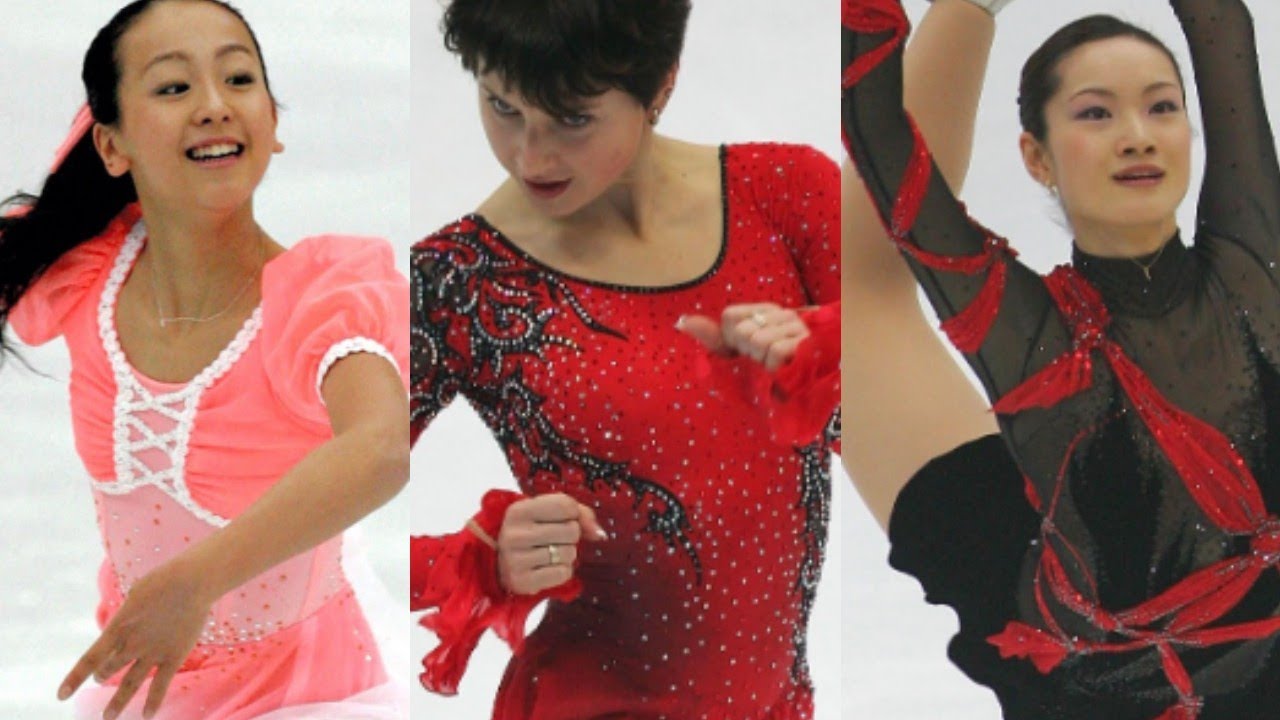
Here’s Maisada. So many fans and experts focusing on the depth of the Japanese team the last couple of years. This is one of the reasons why. Just 15 years of age, not old enough to go to the World Championships or the Olympics. She did not turn 15 until after July 1st, the ISU deadline. Here she is. And one of the few women in the world able to do a triple axle. They’ve been looking very good in practice. She opens with it here. The only one to be planned here at the Cup of China. A little tilted and not quite the rotation there. The combination jumps that she has planned. Difficult. A triple flip double loop. difficult because the second part of that, the double loop, you’re taking off the foot you just landed on. There’s so much buzz about Maada right now because she can combine the difficulty of the jumps with some great style. And her jumps really are effortless when she performs them. Triple H double loop with an arm movement to her waist. I think this program suits her very well. She’s such a believable Clara from Nut the Nutcracker. Guess it suits her much better than her short program where she performed Carmen. We just saw Navkin Costamarov trying to take on that role. It’s much more appropriate. She is the reigning world junior champion. This is her senior Grand Prix debut. Crossarm Bealman there. This next combination worth in base points more than a triple axle. Triple loop, double loop, double loop. And it’s after the halfway mark, so there’s a bonus. There’s a nonchalance with these triples. Just great energy. No stamina issues whatsoever. The final triple luts will change over a flat her final combination spin back camel or catch foot. She often uses the cross hand beman position. It looks interesting. I think it’s a little bit of a cover up fact that she can’t do a full beman. But she’s going for this positions. Difficulty in every way, every place. This is a dynamic young skater. She will be exciting to watch. Absolutely. And we can compare her to Kimmy Mesner, also 15 years old, but she’s eligible to compete in the Olympics this year. You can envision Asana making it to the Grand Prix final, making it to the podium there, but not yet old enough to go to the World Championships. The Japanese Federation’s saying that they’ll take it up with the ISU at that point. This the triple axle attempt. Just a little tilted. Does not get the right knee through. So she’s leaning back, unable to complete the rotation. The triple lets double loop. Little bit of a change over, but see the arm the arms on the hips. A little variation there. This a difficult combination. Triple loop, double loop, taking off on the same foot you’re landing on. That takes great power and control to stay over that right hip. I’ve seen a personal best of 119.13 as a junior skater where you’re limited with time regulations and other restraints. Harder to score high. That’s huge. That number pretty good here. In fact, that’s terrific in her senior Grand Prix debut. 113.68 for her freekate. Overall, 176.60. And that’s a smile we’re going to get used to seeing over the next few years. You know, life is good when you can start a sentence. One of the highlights when I come to Beijing, he’s lead a pretty good life. Shizuka Arakawa on the ice right now. The 23year-old and the world champ in 2004. Some of those skating here, their best scorers, Luta 1929, Arakawa 182.19. Just to give you an idea of what great scores are. Of course, Sasha Cohen with the best and three of the best uh since this system’s been implemented a few years back. Here’s Arakawa in third place after the short program. More than 12 points away. And what a contrast to see Arakalo right after Malasada. She will be fighting for a position on that team. Triple Luts, double toe loop. Very nice. And her triple luts a much more solid edge entering. She presses that edge and it stays compared to that of Assad. Triple S, triple toe loop. The judges really looking at Arakawa for cheated jumps in the second jump of a combination. That being an underturned triple triple flip. Very good. This this what I like about Arakawa is the maturity that she skates with and the command of the ice. Her skating skills very strong. Beautiful flow and maintenance of leg line. Heat. Heat. Seven lots in our program. Not a combination. Again, that secure edge really making it a true LUTs. This combination spin is changing. edges, catching her leg, gaining levels of difficulty with a lot of confidence, speeding up that catch leg. For my money, the interpretation of this music is excellent. The passion that she’s pouring into it, she’s not breaking character at all. She’s been battling boot problems traveling from Russia to Japan, but I couldn’t tell any of that. No, you’re right. What really stands out was that intensity in her performance, that relationship that she had with the music and how she kept that up throughout. Excellent. This is the best we’ve seen from her in some time. Mention the travel training in Japan, training in Russia. Tatiana Terasa back in Moscow. She’ll go there from here to train. The triple S double to she opened with 7.3 base points. Very high. Very nice ride out there. This triple sa cowo very good but then the triple toe under rotated I believe slightly and the judges really looking for that from Shizuka to Raza really getting into it. She had some beautiful positions in her spiral. A turnover, a layover in the spiral earning more recover. When you slow that, it’s amazing how she stays up on the ice. Just about parallel to the ice. There’s Tatiana Terrasa the kiss and cry. Now she was about 5 and a half points behind Maisada after the short program. Big numbers there, especially the program components. The freekate total 116.04. 04. So 173.60 Suzuka Arakawa currently in second place. Still to skate Arena Salute Skaya her first freekate, the official one at least of this season. First though, she takes a look at a Bilman spin. Way the scoring works in this sport. On the ice, set to go. The 29year-old from Kiev, Yolena Leia Shenko, currently in fourth, 12.7 points off the lead. Remember though, Cup of China 2003, she went from seventh to first. Elena Leia Shenko opens with a triple double combination that’s worth almost as much as a triple axle. Triple Luts, double toe loop. Good ride out. She telegraphs her jumps quite a bit. She’s been to 11 world championships and three Olympic games. quite a lot of experience. She too has that command through her upper body like Shizuka Arakawa showing maturity and that experience ball. Nice stretch line in this flying camel. Layover position. Change of edge to the inside edge. Showing that capability of paneling difficulty. And here an example of how the new judging system is changing the way skaters are approaching their programs. This transitional moment in the program choreography and it’s all marked by the judges captured in the program components. I mean talk about that new scoring system and the development of it. It was really, as I mentioned, at this event 2003 that we all sat back and went, “Wow, you can make a comeback with this new system when she jumped seventh first.” Much more than in the old system. I think that’s the best part of the system is that unexpectedness. deep in the program. The triple flip double toe loop also works the same as a triple axle in the base value. So it’s almost like why bother with a triple axle if you if you risk it for the glory Susie. She is just on her game these jumps. Just checking them off her jump list. But beautiful spins. Everything’s really consistent. Heat up here. A strong performance from Elena Leia Shenko. One mistake at the end of the program, but really I like this program to Westside Story. She’s so sure-footed, very dependable. see if she can move up. She was less than a half a point out of third place after the short program. Yolena Leia Shenko, the veteran from Ukraine. She’s got to have the best lap in skating. Don’t you think? A great motto to live by. Don’t falling down. Mahasada is your leader. Suzuka Arakawa, then Leah Shenko. But here is the reigning world champ and looking to repeat here at Cup of China. 26 years of age. We’ve been watching her for a number of years since she won that first European title. Became the first Soviet or Russian woman to do so. From Moscow, the leader after the short program in a healthy lead of 7.3. What to look for in her long program. Six triples, three in combination, beautiful Balman positions, difficult spins and spirals. Marina Slutskaya known for her stability and spring. She has superb lift on her jumps and she works the new judging system. She opens here the triple combination super high. She decides not to do the combination. By the way, the marks for Yolena Leia Shenko 160.7 the total, which as we saw put her in third place overall. Triple S count, double toe, double loop, 7.3 base points there. Arena has approached this competition like the start of a political campaign, gathering support, working out problems, and proving herself. every point of this program. Very invested physically. She never lets off. That energy level. Triple flip. I think the height in the air just makes her jump stand out compared to a lot of the ladies. Not so much the entry. The entries sometimes are a bit sloppy, but the power and the height that she gets really overcomes that. If you’re a skating fan, you know her story. I mean, a couple of seasons ago, there was a point where we didn’t think we’d see Arena Slutskaya back on the ice, let alone skating at this level. vasculitis, the inflammation of blood vessels, paricarditis. We learned a lot about those diseases. Most of us didn’t know what they were before. We heard them from her. Still recovering, but certainly at the top of her game on the ice. Tano variation on that triple flip double toe combination makes it even more difficult. The triple loop could save. Both of those jumps getting a bonus because they’re after the halfway point. Nice low position on the back sit and a back fuelman position. Very difficult. Just ambidextrous. You can do that fuelman spin both directions. In the short program, we noticed that she had such high levels that her elements were ratified as level four. And that’s what I meant by starting off a season with that kind of support, raising the expectations for the Olympics. That’s what’s going to be hard about Michelle coming wing into the season later because of her injury. Solid center. Just watch the circle the blades making from the spin. She really has her alignment down pat. It’s hard to believe the program’s already over. And she doesn’t even look tired. I mean, she is. It did fly by though, didn’t it? It did. That’s a sign of a great skater. Arena Slude Sky bit winded now though you can tell it taking a long time to get to the center of the ice to take her bow but the injuries to Michelle Quan Sasha Cohen this is your favorite right now for Olympic gold come back and check her marks she’s going to win gold skaya finally catching her breath now in the kissing cry after uh good way to open up for Grand Prix season very good way Two elements comparable in base value to the triple axle. Triple sa cow double toe double loop. Very good height on this double toe. A little bit off. So she has to save the double loop but great height. Just the way she comes up in the air. She can be a little loose in the air now. The arm over her head in the tano position. Just a little extra difficulty but she really owns this combination spin getting very low on the sit spin the layback catch foot everything seamless. It just blends so beautifully together. And then on the change right here, the change foot, she’s able to maintain power. So few skaters can maintain that into a back field and showing her ability to be flexible in both directions. And she’s right. It does look better on the ice than out on the pavement. Now, I hate to ruin the drama for you, but she’s going to win. The massive component score, she’s in the eights on a scale of 10. Three different components. Fabulous. 125.90 and 196.12. She not only wins, remember how close she was to Sasha Cohen’s short program total, the best we ever saw. She’s extremely close to her overall total. In fact, she is within 1.5 points. That’s amazing. So, Skaya wins the gold. Maada, her Grand Prix debut, she wins the silver ahead of Arakawa, the former world champ from Japan. And your top three
– American/Australian coverage (commentators: Bob Wischusen, Paul Wylie, Susie Wynne). Remastered video.
– Ladies/women’s free skate (FS) performances from the 2005 Grand Prix Cup of China (Beijing Capital Gymnasium, China, 5 Nov 2005). Performances shown here marked with (*) below:
Rank Name Nation Total points SP FS*
1 Irina Slutskaya Ирина Слуцкая Russia 196.12 1 70.22 1 125.90*
2 Mao Asada 浅田 真央 Japan 176.60 2 62.92 3 113.68*
3 Shizuka Arakawa 荒川 静香 Japan 173.60 3 57.56 2 116.04*
4 Elena Liashenko Олена Ляшенко Ukraine 160.70 4 57.52 4 103.18*
—
[NY Times] Slutskaya and Kwan Taking Different Routes to Their Next Encounter
By L. Zinser, Nov. 9, 2005
Irina Slutskaya, the defending world champion in women’s figure skating, found herself missing her longtime rival, Michelle Kwan, at the Grand Prix competition in Beijing over the weekend. They have been competitors for so long — Slutskaya is 26 and Kwan is 25 — that they have become a two-person club.
“The other girls are so young,” Slutskaya said, laughing, during a conference call yesterday from her home in Moscow. “They’re not our generation.”
As similar as they have been, Slutskaya and Kwan are taking drastically different routes to what could be one final encounter [at the Winter Games], in February in Turin, Italy.
Slutskaya has gained strength in the past year, winning the world championships and gliding away with first place in the Cup of China, her first international event of the season. She did it despite a long battle with vasculitis, an inflammation of the blood vessels that causes fatigue and pain. The disorder cost her the 2003 season and still requires medication to control.
Kwan has struggled since winning her ninth national title last January. She stumbled to fourth in the world championships, with the new scoring system highlighting the lower difficulty of her routines compared with those of her top rivals. This fall, she had a hip injury during training and withdrew from both of her scheduled Grand Prix competitions, Skate America and the Cup of China.
“I was so sad not to find her at the China Cup,” Slutskaya said. “When you know a skater for a long time, skating everywhere together, you feel some people who get close to you. We are friendly and I wish to talk to her.”
Back when they were chasing their first [Winter Games] in the mid-1990’s, Kwan and Slutskaya were the bright new faces of their sport. They were medal favorites in Nagano in 1998, and experienced their first [Games] disappointments. Slutskaya skated poorly and finished fifth, and Kwan watched 15-year-old Tara Lipinski win the gold medal while she settled for silver.
In 2002, the two were stunned by 16-year-old Sarah Hughes, whose spectacular long program earned her the gold. Slutskaya finished second and Kwan third. With all that baggage in tow, they hope to return to the Games to triumph as the sport’s grande dames.
But Kwan’s injury has made her a mystery this season. She will not participate in a major competition until the national championships in January.
To make the Turin 2006 team, she will have to finish in the top three.
Complicating the American scene is another hip injury, to Sasha Cohen, who also withdrew from Skate America but who plans to participate in one Grand Prix, in Paris later this month.
In their absence, Slutskaya has established herself as the favorite for gold. The difficulty of her programs plays well in the sport’s new scoring system. She also seems to relish the chance to keep skating, having dealt with her illness and having lasted far beyond the career expectancy of a singles skater.
“I feel so good right now it doesn’t matter,” Slutskaya said. “It doesn’t matter how old you are, just how professional you are.”