
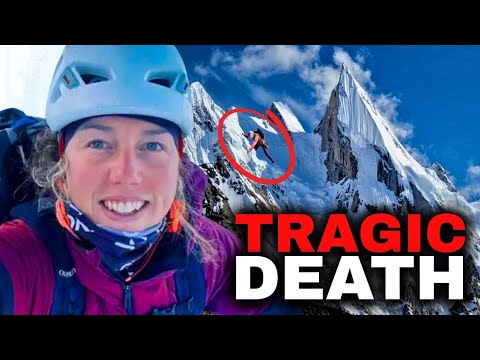
ローラ・ダールマイヤーは世界を征服したが、この山が彼女の命を奪った!
On the morning of July 28th, 2025, deep within the treacherous heights of Pakistan’s Caracorum range, a silence fell over the slopes of Leila Peak. The air, thin and cold, carried an eerie stillness that only mountains know. Somewhere near 5,700 m above sea level, Olympic champion and worldrenowned mountaineer Laura Dalmire vanished into that silence. What began as a bold ascent would become her final journey. A mystery frozen in snow, rock, and whispers. The world would come to know that Laura had perished, struck by a rockfall during descent. But the story of how and why she ended up on one of the most dangerous peaks in the world is far more than a tragic headline. It’s a story of ambition, obsession, mystery, and a woman who followed her own path into the clouds. With some tragic news from the world of athletics, the German bathlete and two-time Olympic champion Laura Dalmire has died following a climbing accident in Pakistan. The mountain that called her. Leila Peak is not for the faint-hearted. A blade of ice cutting through the Kakorum skyline. Its ridge lines are as beautiful as they are deadly. Fewer than two dozen climbers have reached its summit, and many never returned. So why was Laura Dalmire there? She was already a legend, a double Olympic gold medalist in Batlon, seventime world champion. She had conquered the world of winter sports only to vanish from it in her prime. In 2019, she retired suddenly, walking away from the spotlight with an enigmatic smile and a single sentence. There are other summits I want to conquer. Was she running toward peace? Or was she haunted by something no metal could satisfy? What drives a world champion to seek silence in places where even the wind dares not linger? Perhaps it was the rawness, the authenticity of the mountain, no judges, no crowds, only the heartbeat of the earth beneath your feet. For someone like Laura, whose entire life had been governed by split-second decisions and relentless competition, the mountains offered something pure. The descent that never ended, what we know is chilling. Laura was descending with her partner, Marina Eva, when the rockfall struck. They had summited successfully. The weather was calm, but in the mountains, calm is a lie. Without warning, a barrage of rock and ice thundered down the slope. In seconds, Laura was gone. Marina survived barely. Her voice broke over the emergency radio. Laura’s gone. The mountain took her. Rescue helicopters scoured the slopes the next day only to find silence. No movement. No signs of life. The terrain was too dangerous. The mountains message was clear. She stays. And chillingly, it aligned with Laura’s own wishes. In a letter left behind with her climbing group, she wrote, “If I fall, let me rest where I land. The mountains have always been my cathedral.” That sentence has since become etched in the memories of climbers around the globe. The idea that someone could so completely embrace nature’s beauty and brutality was emblematic of who Laura was, a woman of ice and fire. To the world, she was the darling of the Batlon track. graceful, humble, fierce. But those who knew her spoke of something deeper, an insatiable hunger, not for fame, for purpose. After her retirement, she vanished into the wilderness. She became a certified mountain rescue guide, studied environmental science, and quietly summited peak after peak, Amad Delum, Great Trango Tower, and more. Her social media was sparse but poetic. One haunting post from last year read, “Some people fear the void. I call it home.” She spent time in monasteries learning to meditate and focus her mind. She often wrote about how the silence of the peaks mirrored the silence within. Her writings reveal a woman grappling with the immensity of existence, balancing between the external summits and the internal ones. Was Laura searching for something or escaping from something the world never saw? Or was she simply and beautifully trying to feel small in a universe that too often put her on a pedestal? A legacy written in ice. In death, Laura has become a legend. But legends leave questions. Why Leila Peak? Why now? She had no public expedition announcement, no sponsorship deals, no film cruise. It was a silent climb, a private one. just her, the ice, and her closest companion? Was it a test, a pilgrimage? Or had she seen something on that summit few ever do? There are rumors, whispers among climbing circles that Laura had become obsessed with Leila. She had studied its geography relentlessly, mapped its ridge lines in her sketchbook, and written about it in coded entries in her journals. “It speaks to me,” she reportedly told a close friend. Not with words, with stillness. We may never know what drew her so irresistibly to that peak. But we do know this. She died as she lived, defying gravity, boundaries, and expectation. The world reacts. The news hit like an avalanche. Tributes poured in from every corner of the globe. The German president called her an eternal symbol of courage and peace. Former competitors wept on live television. And in her hometown of Garmish Partoners, a haunting candlelight vigil wound through the snowy streets. The bialon world held a special tribute during the World Cup finals. Athletes skied a lap in her honor, rifles strapped across their backs, tears streaming down many faces. The stadium fell into an unforgettable silence, broken only by the sharp crunch of skis on snow. But for every tear there was awe. Because Laura had done what so few dare, she lived on the edge of the possible. She showed the world that greatness is not a medal, but a mindset, the final message. In her last known journal entry, scribbled hastily at base camp before her ascent, she wrote, “I feel it. Something waiting above the clouds. If I don’t return, know that I reached it.” Her words now echo across the climbing world, etched into the minds of those who ascend and descend with the weight of dreams. They have become a rallying cry etched into ice axes engraved on memorial plaques and tattooed onto the arms of young climbers. And so the mystery of Laura Dalmire endures. She disappeared into the thin air of Leila Peak, but her presence has never been more powerful. Every mountain now carries her echo. Every ascent whispers her name. She is not lost. She is legend. Echoes that won’t fade. In the weeks following her disappearance, an initiative was launched in her name. The Dalmmyer Foundation for Alpine Wisdom. The foundation is committed to supporting sustainable mountaineering, educating young adventurers on safety and ethics, and providing scholarships to women in mountain sports. Memorial climbs have been held around the world. From the Alps to the Andes, climbers gather, tying purple ribbons on their gear, whispering her name before stepping onto the ice. Children in Garmish read from her journals during a special school assembly. A group of local girls began training in Bathlon and climbing. Inspired by her story, a young girl was heard saying, “I want to be brave like Laura.” The mountain remembers. It is customary among Himalayan communities to whisper the names of the fallen to the peaks they loved. It is believed that mountains remember. Leila Peak will now hold Laura’s name in its icy heart. Her final breath caught on that windswept ridge has joined the eternal conversation between earth and sky. And perhaps in the swirling wind that dances down the valley at dusk, one might hear her laughter, light and sure, urging us to ascend. Not just mountains, but ourselves. She didn’t just climb. She ascended. And through her story, so do we. If you found her story inspiring, powerful, or even haunting, we invite you to help keep her legacy alive. Like this video if her final ascent touched your heart. Subscribe to our Fatal Limits for more powerful stories from the edge of possibility of people who dare, dream, and defy. Leave a comment with how Laura’s journey impacted you or share the name of someone whose story deserves to be told. See you next time. [Music]
On July 28th, 2025, Olympic champion and world-renowned biathlete Laura Dahlmeier vanished during a descent from Pakistan’s treacherous Leila Peak. What began as a daring alpine ascent became her final, silent journey into the clouds. This documentary retraces Laura’s last climb and the haunting legacy she left behind — not just as an elite athlete, but as a seeker of something greater.
Why did she leave behind fame and medals for a life of quiet summits and solitude? What drove her to a peak as dangerous as Leila? Through rare journal entries, survivor testimony, and reflections from fellow climbers, we uncover the story of a woman who lived — and died — on her own terms.
If Laura’s story moved you, consider sharing your thoughts in the comments. Subscribe to Fatal Limits for more powerful explorations of those who defy limits and chase the impossible.
#LauraDahlmeier #LeilaPeak #FatalLimits
Disclaimer:
This video contains commentary and narrative interpretation based on publicly available information, survivor accounts, and reported sources. It is intended for educational and documentary purposes under fair use. All rights and media content belong to their respective owners.