
Legal Issues in Emergency Preparedness: Declarations, HIPAA, and Volunteer Liability
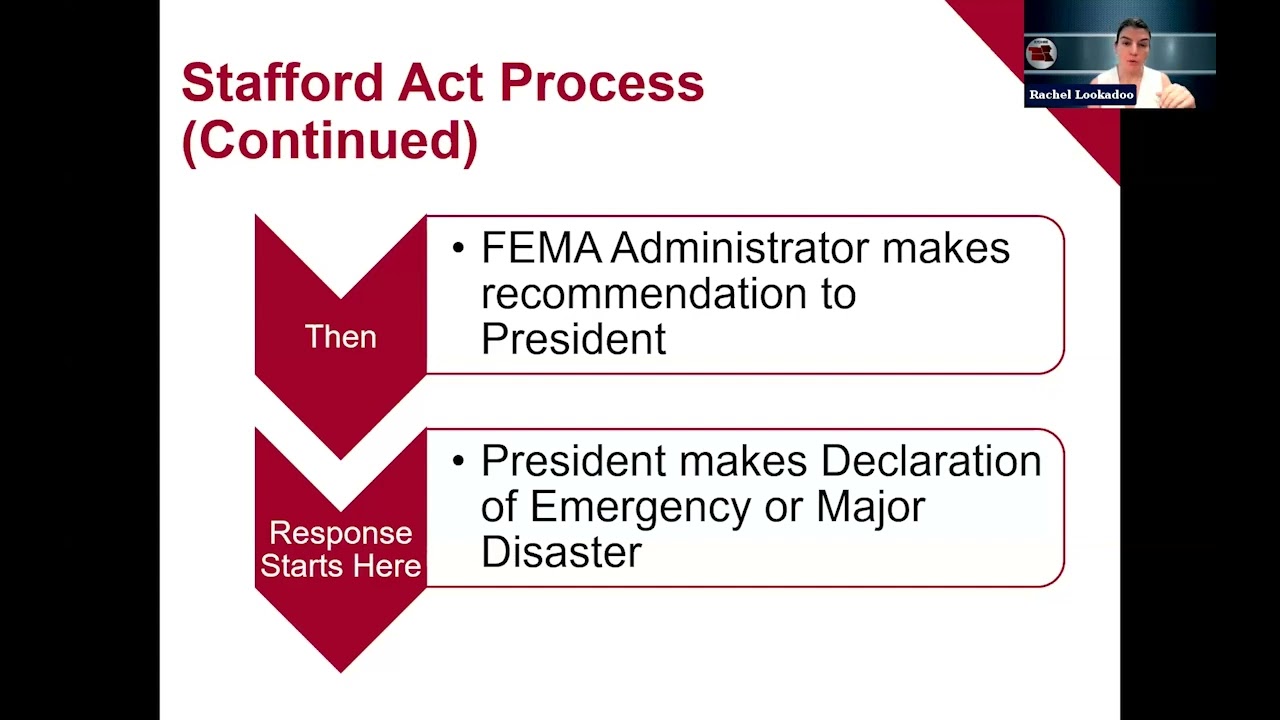
I’d like to welcome everybody to the uh region 7 disaster health response ecosystem webinar for today, legal issues and emergency preparedness, declarations, HIPPA, volunteer liability, and more. I do want to note this is part one of a two-part series that we’re going to be having on these legal issues. I would like to introduce our uh speaker today. Uh today we have with us Rachel Lucadoo. She is an assistant professor in the epidemiology department of the college of public health at the University of Nebraska medical center and serves as the deputy director of the center for biocurity bio preparedness and emerging infectious diseases. She also acts as the director of public health policy for the water climate and health program at UNMC. Miss Ladoo’s background is as an attorney and she focuses on the various legal and regulatory issues that can arise in emergency preparedness and response. She specializes in healthcare surge events, isolation quarantine law, public health impacts of climate change, crisis standards of care, infectious disease response, and general legal preparedness. Miss Lucadoo also conducts emergency preparedness trainings and assessments for public health departments and healthc care facilities nationally. Miss Lucadoo received her jurist doctor degree from American University Washington College of Law and her bachelor’s degree from Baylor University. And with that, I will turn it over to Rachel to lead us on this journey. Thanks. I appreciate it. Well, thank you everyone for being here. Hopefully you can see my screen. Okay. Um, I’m going to just assume yes. So, all right, let’s get started. So today we’re going to be talking about some legal issues in emergency preparedness and we’re going to be focusing in on emergency declarations, HIPPA and information privacy and volunteer management and liability. So any of these topics could be a full webinar on their own. So I want to try and keep this a highle overview. Um and then I’ll have some information on the region 7 states sprinkled throughout. So, I’ll make it clear where the region 7 specific information is. Uh, the rest will apply more generally across the country. If you are calling in from a state that’s not in region 7 and you have questions about your state laws, I may not have that readily available right now, but you are welcome to reach out and I can answer any questions. So, we’ll be going through these three topics and then there is going to be time at the end for a Q&A. Okay. So it would not be a legal presentation without a disclaimer. Um so I am a lawyer but I am not your lawyer. So the disclaimer is this is all forformational purposes only. So none of the information that’s contained in this presentation should be considered legal advice. If you want specific legal advice, if you have really uh specific legal questions, then you should contact your own attorney within your state. So, I want to make two other disclaimers. One is that I’m going to be presenting on what the laws, the regulations actually state and how things are intended to work in a disaster. So, obviously, that’s not always the way things go. Sometimes operationally, there’s differences in how laws are interpreted or operationalized. So, you may hear me present a statute and think that’s not the way we do things. That’s not the way it actually plays out in an emergency. and that’s entirely possible. I am just going to be presenting to you how things are intended to go legally. The other disclaimer I want to make is that this presentation is related to the law as it currently stands. So obviously there’s a lot of things in flux at the moment at the federal level. There’s changes happening within FEMA and HHS. So this presentation reflects the law and the current federal agency standings as they exist now and they may be subject to change in the very near future. So let’s start with emergency declarations. I think this is a good kind of baseline um understanding of what happens at the beginning of an emergency. So we’re going to be looking at federal declarations and state level declarations. All right. So, there are two major types of federal emergency declarations that can impact public health and healthcare. So, the first is through the Robert T. Stafford disaster relief and emergency assistance act, more commonly known as the Stafford Act. Uh, and the Stafford Act gives the president the ability to declare a major disaster or an emergency. So these words are often used interchangeably, but there is actually a difference in how they’re defined through the Stafford Act. So per the statutory definition, an emergency may be any occasion where an incident has overwhelmed state or local emergency response efforts and federal resources are called upon and needed to supplement. So this definition is really broad and it’s broad enough that it can include public health threats. So a major disaster on the other hand is almost always a natural disaster which has caused severe damage beyond a state’s capacity to respond. So the benefit of a Stafford Act declaration is it frees up various other emergency response tools. So this means that once the president has declared an emergency under the Stafford Act and this is generally what is meant when you hear news about the president has declared an emergency and wherever those are normally Stafford Act declarations. So once that declaration has been made FEMA the Federal Emergency Management Agency is then able to provide assistance both to individual households and the broader community at large and coordinate relief efforts. So before we get into how these declarations functionally work, I wanted to share some examples of when Stafford Act declarations have been used for more health related emergencies. So Stafford Act declarations have traditionally been used pretty sparingly for public health emergencies um more for things like hurricanes, wildfires, extreme storms, things like that. But they have been used for health concerns all the same. So obviously they were used with COVID but I also wanted to share some non-COVID examples uh where Stafford act declarations have been used. So the first I wanted to share was back in the year 2000 there was a Stafford Act declaration for the health impacts that existed around West Nile virus specifically in New Jersey. So this was a declaration by President Clinton. Then in 2016, President Obama uh declared a federal emergency in Flint, Michigan. That was a result of the water crisis there. So the declaration was intended to help uh guarantee more access to clean and safe water. And then this was just one that I found interesting to be honest. Uh so back in 2022, President Biden declared an emergency for a sudden huge influx of seaggrass in the US Virgin Islands that was causing major health impacts and was also disrupting the water supply in the US Virgin Islands. So I share all of these to say that Stafford Act declarations aren’t limited to maybe what we would traditionally consider emergencies or disasters, but can be used for all sorts of health emergencies. So, I want to briefly share how Stafford Act declarations functionally work because I think we hear a lot of things in the news sometimes about the president declared an emergency, but it’s not always clear how that plays out from that point forward. So, basically with a Stafford Act declaration, it starts with some sort of emergency occurring, some sort of disaster, and the impacts get to a point where the governor of the given state or where there’s a national emergency. Many governors uh realize it’s to a point where additional help is needed beyond what the state has available. So the governor will request an emergency declaration. At that point, the regional director of whatever region that state is in uh of FEMA will conduct what’s called a preliminary damage assessment. So this assessment or PDA is a really holistic assessment to look at what’s the impact and the magnitude of damage um from this given emergency. You know, what are the immediate needs? What does the state need? What does the community need? What’s the cost? You know, are there other disasters going on at the same time? Are there other federal assistance programs who may be at play? So really a pretty comprehensive assessment. So this FEMA regional director makes this assessment and they submit it to the FEMA administrator. At that point, the FEMA administrator looks over that assessment and makes a recommendation to the president on whether or not the president should make a declaration. Then based on that recommendation, the president will make a declaration of either an emergency or a major disaster. So once that presidential declaration is made, FEMA starts to kick things into action. That is the way the process is intended to go. I realize that sometimes it may not always go that way. So president makes a declaration. FEMA then notifies the requesting governor and any other relevant response agencies so that response teams and other resources can start to be deployed. FEMA also will appoint a coordinating officer who will oversee the response efforts in the region and the governor will appoint a state coordinating officer who will liaz with that FEMA representative to have a a joint effort in response. So the other primary type of federal level emergency declaration that I want to talk about as it relates to public health and healthcare is the public health emergency declaration or PHE. So these declarations are authorized by the public health service act of 1944. So this type of declaration occurs if the secretary of HHS, the US Department of Health and Human Services, uh determines that there’s a disease or a disorder that presents a public health emergency or that there’s some sort of public health emergency including a significant outbreak of disease, bioteterrorism attack, whatever the case may be, some sort of scenario that impacts health. So once that PHE has been declared, the HHS secretary and the agency as a whole can start to conduct investigations into whatever the given PH is, whether it’s a disease or whether it’s something else. So these declarations last for the length of the emergency or for 90 days, whichever comes first. If the emergency extends beyond 90 days, if the 90-day mark hits and the emergency situation is still in place, the PHE declaration can be renewed and continued. So, for example, we saw that with COVID, the public health emergency declaration um was extended a number of times as that emergency continued. So, PHEs aren’t just limited to diseases. They’re often used for natural disasters, particularly those that impact health or those that may disrupt or impact access to healthcare resources or healthcare delivery. So, PHEs or public health emergencies are starting to be used more often for different types of public health threats. So, for example, back in 2018, um, a public health emergency declaration was issued for the opioid crisis, uh, and that declaration has been consistently renewed since that time, for all seven years since then. It’s still in effect now. It actually was just renewed in March of this year. And there’s been a call for more use of public health emergency declarations. So people want to see them for things like extreme heat and other types of a little bit more um just different types of of less concrete types of disasters uh and more of these kind of higher overarching issues. So part of the call for this and this request for more expanded use of public health emergency declarations is because these types of declarations allow for more federal resources to be dedicated to addressing a given emergency. They also allow the HHS secretary to have the authority to wave certain uh statutes, regulations at a federal level that may hinder or slow down emergency response. And we’ll talk about some of those waiverss in a second. And then finally, these kind of declarations also provide greater awareness and can shine a light on public health issues that may not be as readily acknowledged. So, for example, by declaring the opioid crisis as a public health emergency, it brought more public attention to the severity of the situation and made it more of a pressing issue for people across the country who maybe had not been as aware of just the scope and magnitude of the situation. Now on the other side there are people who disagree with this and don’t think that PHE declarations should be used for these more kind of abstract emergencies instead of you know the more what we think of traditionally as disasters. So when we talk about emergency declarations particularly at a federal level uh we should probably talk about 1135 waiverss and we’ll talk about these more in our next webinar in August. Uh, but I just want to give you a little information on them really quick. So, uh, the HHS secretary has authority under section 1135 of the Social Security Act to issue what are called 1135 waivers. They’re named after the section of the law. Uh, and these waivers allow the secretary to wave certain regulatory requirements or sanctions for violating regulatory requirements in an emergency. So the HHS secretary may wave parts of HIPPA uh or MTA or whatever the case may be to make sure that people can still access health care services readily in an emergency and to really reduce the burdens on health care facilities who are already trying to juggle a lot of things in an emergency response. Something that’s really important to know about these kind of waiverss is that they can only be issued if the HHS secretary has declared a public health emergency and the president has declared a Stafford Act declaration or another kind of declaration called the National Emergencies Act declaration. So if only one of those declarations is in place, we can’t have these waivers. But if both of them are in place, then we can have 1135 waivers. So for example uh during the COVID pandemic uh we saw that the public health emergency declaration occurred I want to say like three or four weeks before the presidential declaration occurred. I may be wrong on the exact numbers on that but there was a time difference there. And so what that meant was we couldn’t have these waiverss start to come into place and be activated until both of the declarations were established. So, states also have emergency declaration authority. Um, all states across the country have some general authority for their governor to make some type of emergency declaration. It’s worth noting though, there’s only about 35 states in the country who have specific authority to declare a public health emergency. So, state declarations are really similar to federal declarations. They’re used when a local emergency has exceeded local resources ability to respond and so state resources are called upon to supplement them. So these state declarations kind of like the federal uh can include waiverss from the governor of state level laws and regulations. So this can include things like waving certain healthcare license share requirements. uh we saw that a lot in COVID or public health data sharing that sort of thing can be waved in a state emergency declaration. So an important thing to remember though is that with a state level declaration those can never wave federal laws or requirements. So for example a state declaration could potentially wave a state level data sharing law but it could not wave HIPPA regulations. So it’s really focused in on state requirements. So within region 7, we have a few different declaration types. So Nebraska, Kansas, and Missouri all have general emergency declaration authority. Iowa and Kansas in their statutes use this language of a state of disaster emergency, while Missouri and Nebraska use the term state of emergency. It’s really just a linguistic difference. It doesn’t really have a functional difference. It’s just how they chose to write the statute. But Iowa is unique. Iowa actually has explicit public health emergency declaration authority and they’re the only state in the region who has that in addition to the general emergency declaration authority. Okay. So, I want to show you what this means in statutory terms so you can see the difference because I know that the three states in the region 7 who don’t have explicit PH declarations might be wondering why theirs is different or how that looks different. So, there are going to be just a few slides with just straight up statutory text. I promise it will not happen again. It’s only these three slides. Okay. So, this is the Nebraska Emergency Management Act. This is the actual statute uh that’s used to give the governor authority to make an emergency proclamation in the state of Nebraska. So you can see here in this section three, it has very general language about the type of emergency proclamation that the governor can issue. Basically, if there’s a disaster emergency or civil defense emergency, as you scroll through here, if you look at the rest of the statute, which I didn’t include here, you’ll see there’s no reference to health or public health. So, the reason Iowa is different is if you look at their statute, this is their statute giving um their governor authority to proclaim a disaster emergency. And in this section, artfully highlighted by me, uh you can see that it specifically calls out a public health disaster. And it says that if the governor issues a state of disaster emergency that is specifically for a public health disaster, then their proclamation needs to say that. it needs to be called out as a public health disaster because that kind of opens up some different resources and brings different attention to the type of emergency. So the Iowa statute goes on in a different section to actually define what a public health disaster is. So it goes through here and says a public health disaster could be any of these things. bioteterrorism, novel infectious agents, chemical attacks, nuclear, natural disaster, whatever the case may be. If it’s any of those type of things, and it’s something that poses a high probability of causing a lot of death or disability, exposure to infectious disease, or short or long-term physical or behavioral health issues, then it can be considered a public health disaster. It needs to be called out as such in their declaration. Now, looking at this, I’ll be honest, I think probably any of these types of disasters would cause some sort of short-term or long-term physical or behavioral health consequences, but who knows? So, this is the criteria that Iowa uses to have this specific call out. So, again, I just wanted you to see that because in Nebraska again, and also in Missouri and Kansas, the language is much more general. There’s not that health info, but Iowa has a specific carveout and about 34 other states in the country also have this kind of carveout. Okay, so let’s move on to our next topic. This is HIPPA. Um, HIPPA and information sharing are incredibly relevant in emergencies. You know, it’s critical, I’m sure you all know this, to be able to coordinate patient tracking and data sharing across health care providers, public health professionals, first responders, emergency management, whatever the case may be. So, HIPPA is really relevant in an emergency. So, I just want to give a little bit of basic background information on HIPPA. I know all of us have been to the doctor’s office and got the notice of privacy practices and have probably never ever read it. So, I’m going to just give you a little bit of quick info here. So, HIPPA for your reference is the Health Insurance Portability and Accountability Act. Uh, your trivia fact for the day is that the full name of HIPPA doesn’t say anything about information or privacy. A common misconception there. Also, if you take nothing else from this webinar, remember that HIPPA is spelled with one P, not two. Uh, so HIPPA came out in 1996. That’s when it was enacted. And it’s split into two main parts. We have the privacy rule and the security rule. Security rule is really about the infrastructure around electronic health information. It’s about the systems and the electronic health records that we use to track and maintain health information. The privacy rule is actually about how do we protect people’s health information. So for our purposes today, security rule is a lot of technical details. That’s not really what we need to worry about. So we’ll focus primarily on the privacy rule. So one of the primary issues with HIPPA is PHI. So you may be aware of what PHI is, but just as a refresher, I wanted to define what that means and what it includes. So PHI stands for protected health information. It is any individually identifiable health information in any format. So I want to call that out. That’s if it’s written on a piece of paper. That’s if it’s entered into an EHR, if it’s on an email, if it’s spoken out loud. If you’re in a hallway and you say John Smith is in room two, he was born on June 2nd. That’s PHI. So, PHI can be any demographic data, information about someone’s physical or mental health, um, or about the health care services they’ve received and how they have paid for those services. That all falls under the umbrella of PHI. So, the main tenant of the privacy rule of HIPPA is that PHI cannot be disclosed without explicit patient authorization. And there are some named exceptions to that. and I’m going to go over them in a second, but important to keep that in mind. So, this is strictly for your reference. I’m not going to read this to you, but these are all of the different data points that can be considered as PHI identifiers. Uh, so you can see if you look at this list, it’s a pretty comprehensive set of data that can be used to identify someone through their PHI. So, within HIPPA, there’s a lot of discussion about how do you deidentify someone’s health information? I don’t want to spend too much time on this, but I just want you to be aware because it does come up sometimes in emergency situations, and I’ll give you an example in a couple slides. So, deidentification is a way to make PHI data available to communities. So generally once all the identifiers from the previous slide are removed within a set of data, the use of that data is no longer subject to HIPPO restrictions or other data privacy restrictions. So deidentification actually allows public health and healthcare entities to share data, collect data, and report data without violating HIPPA or other privacy laws. So there’s two established ways to deidentify PHI. Uh, one is called the expert determination method and this is where you bring in someone who’s a subject matter expert who determines that the risk is very low that any information in a given data set could be used to identify someone who’s the subject of that PHI. Uh, and then the other method is called the safe harbor method. And this is where you basically just go through the data set and make sure that all 18 of those identifiers from the previous slide are removed so that that data is now safe to share without risk of any uh legal infringement or HIPPA violation. So when lawmakers created HIPPA, uh they wanted to protect people’s individual information, but I think they also understood that there needed to be some flexibility that allowed health care providers and other covered entities, that’s what individuals or organizations covered under HIPPA are called. So these flexibilities that allowed them to share PHI without the express uh authorization of the patient. So those disclosures have to fit within certain guidelines. So under HIPPA, you can disclose PHI without getting the patients sign off of it in the following scenario. So treatment and healthcare operations for notifications, imminent danger or threats, a facility directory, and then there’s a public health exception. So the treatment category basically just means that healthc care providers can share patient info across providers when they are coordinating patient care. So that can be with another health care facility or it can actually be with an emergency or disaster relief organization who may be involved in response efforts. Uh for the notifications category, this normally involves things like sharing information with family members, friends, others who may be involved in a patient’s care, um or also with disaster relief organizations like emergency management or the Red Cross if they’re coordinating uh family notification or reunification efforts in an emergency. for imminent danger or threats. This means any situation where sharing a patient’s info may be necessary to prevent or lessen a serious threat to the health and safety of a person or to the community at large. So this could mean sharing that there’s a risk of infectious disease transmission um or sharing that there may be a health risk to an individual specifically. So, HIPPA also allows healthc care facilities to use what’s called a facility directory to inform outside individuals or visitors about a patient’s location in the facility and general condition. So, what this means is an outside party can call a hospital and say, “Hey, is John Smith at your hospital?” And hospitals are are legally allowed under HIPPA to say, “Yes, he is here and he’s in stable condition.” They can’t give more information than that, but that kind of very simple baseline information is legally allowable to share. And then finally, public health also has a specific carve out under HIPPA where public health authorities can receive reports of disease reportable diseases or vital statistics, things like that that are public health duties. So for almost all of these disclosures except for the treatment ones, a covered entity or the the facility that’s sharing this information must make every reasonable effort to limit the information disclosed to that which is called the minimum necessary to accomplish the purpose. So basically, if you’re sharing a notification with family members, you can share the immediate information that’s needed for those family members to know, but you can’t share this patient’s full background and history if it’s irrelevant to the given situation. So really limiting the amount of information that’s shared. So the benefit of having these disclosures all clearly established in statute is that these are ready to go at any time. So these disclosures are the law. They are not contingent on anything else. You don’t need an emergency declaration to be able to make these disclosures without patient authorization. So that’s really nice. So that if an emergency occurs, you can start making these disclosures if you need to. You don’t have to wait for some sort of declaration. Okay. So, HIPPA is a federal law, but each state generally has very similar laws on the books to align with HIPPA. State laws, and this is true for almost any kind of state federal law relationship, but specifically here with HIPPA, state laws can either provide the same level of protection as the federal statute as HIPPA or they can be more strict, but they can’t be weaker or more lax. So basically what that means is you know Nebraska for example can have stricter information privacy laws than HIPPA but they can’t have weaker ones. They can’t give less protection for information privacy. So I’ve got a table here on the slide. I do want to give a shout out to our legal intern Aaron Buyerswear who put this together. This is a list of all of the state health information privacy laws for the region seven states. They’re all very well aligned with HIPPA. But I just wanted to share this with you so that if you feel like reading some statutes lately later, you can find where your state specific laws are located. So I wanted to give an example of how these sorts of issues can actually play out in an emergency. And so this is an example from Nebraska. So, back in 2021, there was an issue where Nebraska was not showing up on the national COVID case count maps. So, if you remember, not that long ago, we all lived and breathed by these maps showing us where the case counts were high for COVID. And there was a period of time where Nebraska was not showing up on the map. And this was really going back I think kind of to that disclaimer I gave at the beginning of the presentation about how everyone can operationalize and interpret statutes differently. This is kind of what happened in this scenario. So what what occurred was there was an emergency declaration in the state of Nebraska that waved certain state privacy laws during COVID. That declaration ended. So that waiver ended and then from that point forward based on some attorneys interpretation of the state’s laws data for any county with less than 20,000 residents was no longer included in these case count maps. So that was about 76 of the counties in Nebraska had less than 20,000 residents and therefore weren’t included in these case count maps. Now, I won’t get into whether that was a correct or incorrect interpretation. It’s not for me to say, but I think this is important to show just how critical those understanding and interpretations of health information privacy laws are. Um, because this led to a lot of confusion on what information was available within the state. So really understanding where the confines and boundaries of information sharing is within your state can be important in an emergency in situations like this where information maybe needs to be shared but can’t be based on certain interpretations. All right, so let’s pivot to our third topic. So we’re going to talk about volunteer management and liability. So the number one concern that I hear repeatedly around volunteer management is around liability concerns specifically for spontaneous unaffiliated volunteers versus affiliated volunteers. So just to clarify what those two terms mean, affiliated volunteers are individuals who are attached to an established recognized voluntary or nonprofit organization. They are typically folks who are trained for a specific type of disaster response activity. Um, they are connected with a volunteer organization prior to the disaster. They’re invited to deploy or be involved in a response. It’s a much more organized situation. Spontaneous or unaffiliated volunteers aren’t like that. They’re not part of any recognized organization. They often don’t have training uh in emergency response. These are the folks who see an emergency happen in their community or in another community and just want to be involved and want to help which is a wonderful great instinct but can be a little bit difficult for managing people. Um I will tell you from the outset affiliated volunteers have way more liability protections than spontaneous unaffiliated volunteers. So this is where a lot of that concern comes in. So I want to go over a few different federal volunteer strategies or structures that are used to basically corral and organize affiliated volunteers um and provide some of that liability protection. So the first is EMAC. I’m sure you’re all familiar with EMAC. EMAC is the Emergency Management Assistance Compact. So, this is a mutual aid agreement. It’s been adopted by all 50 states and by I believe all US territories as well. Uh and it basically allows um a state or territory where an emergency occurs, that state or territory can request an EMAC activation uh and then another state can send resources or assets to that state to help with emergency response. So, EMAC also has explicit liability protection and workers compensation protection for outofstate individuals who are deployed in response to an EMAC request. Additionally, there’s something called the nurse lensure compact. So this is a multi-state lensure compact um that allows RNs, LPNs, LVNs who are registered in a state that’s part of the nurse lensure compact or NLC and it allows them to practice in any other state who’s part of the NLC. Now this law is intended to allow nurses to maintain their license across state lines and makes it easier to move and change jobs, etc. But in an emergency situation, it’s also intended to allow nurses to easily deploy as volunteers across state lines in an emergency. Now, I will say we can maybe put that easily in quotes because sometimes that deployment does not always go as smoothly as you would think with lensure requirements. There can be some confusion around uh how that lensure translates, but that is the intent of the NLC. Another one of these structures that I want to uh note is the emergency system for advanced registration of volunteer health professionals or ESR VIP. So ESR VIP uh allows medical professionals to register ahead of time with the registry um as volunteers who will be deployed in some type of declared emergency. So this is great. This system is is great in that it’s intended to already license the volunteers. They’ve already been vetted. They’ve already gone through a background check process. Um, which means you have a good sense of who is actually being deployed in an emergency using this system. Kind of similar, we also have medical reserve corps or MRC. Uh this is a national network of both medical and non-medical volunteers who often deploy in emergencies. Uh they help with a number of different response efforts. As you may be aware, MRC has regional units across every state with individual MRC coordinators for each unit. So for both the MRC and ESRVIP there’s federal liability protection guaranteed where individuals within those entities are acting within the scope of their lensure their certification whatever the case may be uh and they’re not acting beyond the scope. So if you are only licensed as let’s say you know a nurse you’re not going to be doing work of a surgeon you know so acting within the scope of your practice and your training in your lensure uh and also um you have this liability protection where you’re acting as a member of this group either the MRC or the ESRVIP so there is this explicit protection given there so what do we do about spontaneous volunteers Uh so we have people who want to volunteer. They’re not a part of a group. They haven’t been pre-identified or licensed. Uh so what do we do about that? So, I think some of this you all already know, but I will tell you some of the best practices that you can incorporate to really account for these concerns and potentially protect yourself from risk is to ahead of time, in peace time, and quiet time. Make a plan in advance for your unaffiliated spontaneous volunteers. How will you manage them? Who will oversee them? You know, in a response, there’s a good idea of creating a volunteer screening site or center. um for volunteers to come to this one specific location and register so that you can get a good sense of who’s volunteering in your community and reduce some of the risk of having people just kind of go uh out and volunteer without any establishment of who they are and and what they can potentially do to assist. I think it’s also a great idea to encourage engagement within your communities with established volunteer organizations. So the more we can encourage community members to register with, you know, Red Cross or different types of organizations where they can have an established volunteer status before an emergency. I think that is a good protective measure. Uh also when an emergency occurs, make sure you’re communicating often with your community about how you will be handling volunteers in emergency. So if you have a volunteer registration site, point people to that and communicate that to the public as often as Paul as possible. So I I also wanted to share briefly about Good Samaritan laws. This is something I’ve presented on before probably to um some of you who are on the call today, but I think it’s beneficial to review because it does come up when we’re dealing with emergencies. So good Samaritan laws uh just for your awareness are these legal protections for people intervening in an emergency or an accident. So this is more for kind of impromptu on the scene response or assistance rather than a coordinated emergency response. These laws generally apply in non-compensation situations. So they apply when someone is doing something that they are not being paid to do. So that could be a volunteer setting uh or that could also just be someone who sees something happening on the side of the road and pulls over to help. These laws cover actions that are taken in good faith. And what that means is this is where someone is taking action that they genuinely believe will help in a given scenario. These laws do not cover gross negligence or willful misconduct. Those are two legal terms. Gross negligence just means that um the person intervening is showing a lack of care that demonstrates a reckless disregard for people’s safety. They’re doing something that is just blatantly unsafe in trying to help and that actually puts people’s lives in more jeopardy. And then willful misconduct is where someone is aware that what they’re doing could actually hurt someone more than help them and doesn’t do anything to adjust their behavior. they continue to intervene in a way that they know is not going to be beneficial and in fact will be harmful. I also want to share there have been a number of developments lately around laws relating to drug overdoses or administration of nlloxxone or underage drinking where there are laws that are being put into place where um let’s say for example if someone is under the influence of a certain drug and they have a friend or someone near them that they see is overdosing on a drug. first person can call 911 and not be um arrested or charged for also being under the influence themselves. I bring that up because those laws are also called good Samaritan laws, but they’re obviously a little bit different context than what we’re dealing with here. But just for your reference, you’ll see those called Good Samaritan laws as well. Within region 7, we have a little bit of um differences in how laws, good Samaritan laws are in place in our region. So Iowa, Kansas, and Nebraska all have pretty broad liability protection for individuals who help at the scene of an emergency. Missouri is a little bit different, though. Missouri only provides liability protection for licensed health care providers and individuals who are trained in first aid. So essentially in Missouri, if you’re not a licensed healthc care provider or a person trained in first aid and you go to stop and provide help at an emergency scene, you may not be protected from liability. The only exception in Missouri is if any person, lay person, no training, whatever, uh intervenes in a suicide prevention scenario, they cannot be held liable for any uh harm or injury that occurs as a result of their intervention given there’s no willful misconduct or gross negligence. Okay, so that was a lot of legal content and I wanted to make sure we had plenty of time for questions. Before we get into the questions though, and I’ve been seeing the the light pinging that we’ve got some Q&A coming, um I did want to share that we are going to be having another webinar on legal issues and preparedness in August, I believe. Um and that will cover interstate cross-state legal concerns as well as some more federal and state regulatory and statutory waiverss. In addition to that webinar, we are releasing a series of one-pagers on these topics. So, I’ve put here kind of a snippet of the emergency declarations one-pager that should be released on our website here within the next couple of weeks. Uh, and then similar one pagers on HIPPA and volunteer management will also be coming out in coming weeks. And those will all be on our website, which is here. And I’m sure Jackson or Tom can put that in the chat as well. So with that, I will start taking questions. Let’s see what we’ve already got in the Q&A. Okay, so I see there’s a comment. Shouldn’t any disaster basically call out the type of disaster is being directed for? Yes. So any disaster declaration will generally say or they will say here’s the disaster. Here’s what’s happening. it is for this incident that occurred at this state covering this county. If it’s a state declaration, it’ll say it covers these counties. If it’s a federal declaration, it’ll say it covers these states, whatever the case may be. The reason I called out the public health emergency one is because that just creates um a little bit different engagement from the health department, state health department, and different agencies rather than being more general. So yes, all disaster declarations will call out what type of disaster it is, but having that explicit type of public health emergency declaration uh just kind of changes the the nature of the response. Would a police request be considered imminent danger? Okay, so that is in Oh, my questions are moving on. Okay, so that is in regard to HIPPA, I assume. Um and there is a lot of discussion around HIPPA request or HIPPA enforcement around law enforcement. So with police request, if there is an imminent risk of danger to an individual’s health and safety, then it is okay to disclose PHI. Um, but there can also be requests from law enforcement for PHI that is not associated with an imminent danger and that is more kind of investigatory. Um, and there is no obligation to share PHI with law enforcement in those scenarios. It really is only in imminent danger. So, not all police requests would be considered imminent danger requests. Some of them may, some of them may not. Okay, second. Let’s see here. If requirements are met for 11:35 waivers to kick in, are these waivers delineated somewhere or is it just a blanket waiver? How do you find out what is being waved? My interest is in lab related regulations. Okay, so it kind of depends on the situation. So with 1135 waiverss, it depends on the emergency. So for COVID for example, there were a series of blanket waivers that came out under 1135 that explicitly said here are the given uh regulatory waiverss that are in place for all healthc care facilities across the country during this emergency. There were certain health care facilities and different types of entities covered under 1135 who wanted additional waiverss. So they actually wrote to their CMS, Centers for Medicare and Medicaid Services, uh, regional offices and requested additional waiverss. Those were sometimes approved, sometimes not. In a smaller, more discreet emergency, not a national emergency, states can submit requests for specific waiverss that they want. So long answer to your question is sometimes the waivers are very limited. Sometimes they are very broad blanket. It just depends on the nature of the emergency, the scope of where it is being affected um and the types of health care services or facilities that may be impacted. Now, as it relates to lab regulations, I would have to look and see what lab regulations may be included under 1135. I’ll tell you that a lot of those waiverss typically relate to explicitly healthc care delivery regulations. Um, so I don’t know off the top of my head if lab regulations would be included in those waiver types. Okay, I’m just moving through these. I hope that is okay with everyone. Jackson or Tom, you interrupt me if I’m taking too long. So, next question. Who has authority to activate or request EMAC, ESRVIP, MRC’s and are declarations required? Declarations are generally required I believe for all three. Um the governor believe the governor is who makes the EMAC request. ESR VIP and MRC’s I don’t believe is a governor activation. I would have to look. I don’t want to give you wrong information. Um, but yes, I do believe a declaration is required for all three of those, specifically governor authority to activate and request EMAC assistance. I’ll check on the other two. All right, next one. As a small rural hospital, our current plan is to respectfully decline volunteers and then contact local EMA if we need assistance. Any concerns or opinion on that? Okay. So, again, not explicit legal advice. However, I think that’s actually a great plan. Um, I think it can be um it can be really risky to take on volunteers that you don’t know who they are, you don’t know their background info, you don’t know their training. There is a lot of risk involved there. And I think if that is an approach that you all are comfortable with, then I think that is perfectly fine. Again, unofficial, not not legal advice. Okay. I live in Missouri and thought our Good Samaritan law would cover folks in emergency situations. Am I incorrect on that? So, I will tell you, I’ve had a lot of conversation with folks in Missouri about interpreting that. Um, and I would honestly defer to the Missouri State Health Department and Missouri lawmakers on their interpretation of those laws. The way I have read the statute is that it it does explicitly call out licensed healthc care providers and individuals trained in first aid. Um it does not say anything about lay people, bystanders who are involved in an emergency situation. All three of the other states in the region do have that explicit call out of bystanders who get involved in an emergency. I haven’t seen that in the Missouri statute. The only uh the other thing that makes me think that is that the Missouri Good Samaritan law goes on to say that bystanders um can intervene in suicide prevention scenarios. So it explicitly calls out bystanders there, but not for any other type of emergency scenario. So that’s my understanding of the Good Samaritan law in Missouri. Again, it may be worth asking your Missouri State Health Department attorney or other contacts there for more information. Uh, what obligation do I have to train my volunteers in HIPPA? What is a good resource for training volunteers in HIPPA? That’s a great question. There are one I would say yes, it’s is good to just train anybody in HIPPA. I’ll show my hand here and say that I used to work in healthcare compliance, so I feel fairly strong about understanding HIPPA. Um, but there are a number of different um healthcare compliance organizations and other entities who provide great HIPPA training for a range of different audiences, including volunteers. So, I can’t think of a specific volunteer one off the top of my head that I would point you to, but it should be pretty easy to find. And if you find one that you’re curious about and want to know if it’s a legit one or a good one, you are welcome to reach out to me, email me, and I can let you know my thoughts on it as well. Okay, I think we only have two more. We’re doing good on questions. So, for Missouri, Good Samaritan Law follow-up question. The liability protection for persons trained in first aid. Does the first aid training need to fall within a specific time frame or certification criteria? Oh, I have that information and I don’t know off the top of my head. Um, man, I just looked at this not that long ago. I will tell you from what I recall that training certification, basically what it entails is if someone is trained under a specific program, like if they’re trained under stop the bleed, then they can only be protected as long as they are acting up to the level of training that they received. So, if they only have training in that one specific area, then they’re not protected for any actions they take outside of that first aid training. Now, I don’t recall off the top of my head the time frame or certification criteria. Apologies for not remembering that. I can find out and get back to you if you want to email me with that question. I’ll respond to you on there. Okay, Melanie. Let’s say I’m a person who has let their first aid certification and CPR certification lapse. I’m traveling through Missouri and come across an accident. Since I’m no longer certified, if I stand there and let people die, I’m protected by the law. But if I try and help and the people die, I’m liable. How do we get this changed? My reaction will be to help no matter my certification. This isn’t the case for everyone, but it is the case for a lot. Yeah, Melanie, I think that’s a valid concern. Like I said, this is something that I’ve had um a lot of conversation with folks in Missouri about and I think there are a number of people in the state who are looking at how potentially that law may be changed or adjusted or the wording addressed to be more comprehensive. I think that is just a matter of lobbying and advocacy to make sure uh that law is up to date. Good Samaritan laws. Um, originally, well, maybe not originally, but many Good Samaritan laws across the country were written for the intent of protecting health care providers who helped at the scene of an emergency while they were on their off hours. So, it was written for this kind of different type of scenario. Um, so there really is a smattering of states across the country who don’t have express good Samaritan protections for individuals who are just lay people or bystanders. It would be great if that changed because it’s very confusing when different states have different understandings of good Samaritan laws. It’s hard to know across state lines if you’re going to be protected or not. So I agree with you. It would be it would be nice to see a change there. All right, I think that was all our questions and we got two minutes to spare. Anything else? I I do want to remind folks that because it came up in one of the questions and everything. Um, in the next couple of days, we’ll have this webinar posted on our website for anyone to refer back to should they need to. Um, it’s a great resource. Uh, legal is always just fun. you know, um, but it it’s one of those things that we all need to make sure that we are we are well aware of and well verssed in. And so I certainly appreciate Rachel uh coming and speaking to us all this. We all look forward to uh on August 13th we’re going to have part two of this. Um the registration’s in the chat there if if you want to come join us for that also could be found on our website. Um, and I appreciate everybody showing up today and asking some great questions. Um, you know, we’ve listened to the uh the volunteer liability before and had all the same questions and it’s it’s kind of shocking when you find them out. So, uh, yeah. And I’ll just say again, if questions come up or if people want to talk about any of these things more, it’s pretty easy to find my email address. Don’t hesitate to reach out with with further questions. Yep. All right. Um, one one last comment there and then we’ll we’ll let everybody go to respect time here. Asks mentions a duty to respond expectation in Missouri for medical lensure, hence the need for explicit good Samaritan coverage. Yep, makes sense. All right. Again, I thank everybody for coming. I thank Rachel for giving her time to to us and uh hopefully we’ll see you all on the second one in August. Thank you much and uh have a great day everybody. Thanks everyone.
Join us for a 2-part webinar exploring the legal landscape surrounding emergency preparedness. These webinars will cover critical topics such as emergency declarations, HIPAA compliance, volunteer liability, and more. Our expert speakers will provide practical insights and strategies to help healthcare providers and public health professionals navigate these complex legal issues effectively. Don’t miss this opportunity to enhance your legal preparedness for any public health emergency.
Webinar Objectives:
o Define what an emergency declaration is and the criteria needed for one to occur.
o Discuss HIPAA compliance and its legal implications in a disaster.
o Explain volunteer liability and how it applies during a disaster.
To find out more about the work of the Region VII Disaster Health Response Ecosystem, please visit our site at https://www.regionviidhre.com/